
Rigid vs. Flexible PCBs: Which One is Right for You
Learn how rigid PCBs compare to flexible PCBs, when it’s better to use one type over the other, and learn about some of the manufacturing steps associated with these PCB types.
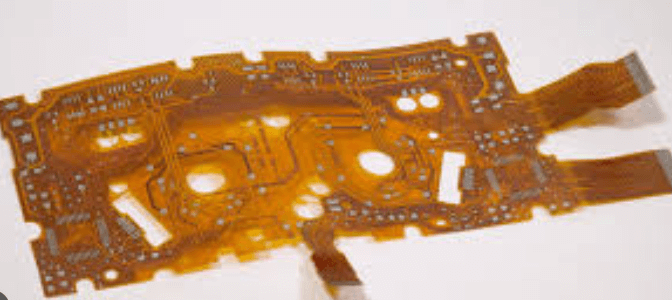
A Printed Circuit Board Isn’t Always a “Circuit Board”
When the term “PCB” is used, many people think of a rigid PCB (printed circuit board). However, the term PCB can refer to either a rigid PCB or a flexible PCB. Flexible PCBs are often referred to as flex circuits, but they are also known by other names including flex boards, flexible circuit boards, flexible printed circuit boards, and more formally, flexible electronics. Flexible circuits have gained tremendous popularity recently because they can be shaped, bent, twisted, and folded into endless configurations. Ultimately, however, rigid PCBs and flexible PCBs serve the same ultimate function in the most basic sense, which is to connect various electrical and mechanical components together.
When to Use Rigid and When to Use Flexible
Rigid PCBs typically cost less than flexible circuits. I say “typically” because when considering the total cost of ownership, there are some applications where it may be cheaper to use flexible PCBs than to use rigid PCBs. To really get an accurate picture of the total cost of ownership, the first thing you need to understand is that flexible circuits can eliminate the need for components such as connectors, wiring harnesses, and other circuit boards. By removing these components from the design, material costs, labor and assembly costs, and scrap costs are all reduced.
Many electronic devices (laptop and desktop computers, audio keyboards, solid-state drives (SSDs), flat-panel TVs and monitors, children’s toys, and various electronic devices) employ rigid PCBs rather than flexible PCBs. However, flexible circuits can be found in ultra-compact and/or high-performance devices, including GPS units, tablets, smart phones, cameras, and wearables.
Greater complexity is not the only reason to use flex circuits; low-tech applications (such as under-counter LED lights, see figure below) may employ flexible circuit technology, which in some cases makes installation much easier.
Finally, if desired, flexible and rigid circuits can be used together as a unified PCB. Perhaps, this approach can offer the best of both worlds. See Figure 2 below.
Some Similarities and Differences Between Rigid PCBs and Flexible Circuits
When designing rigid PCBs, certain design rules must be followed, including minimum hole sizes, minimum space and trace widths, minimum distances to the edge of the board, and copper and overall design thickness. In addition, many manufacturing process steps are shared between rigid and flexible PCBs. These process steps include drilling and plating of holes and vias, optical imaging and development, etching of copper traces, pads, outlines, and planes, and heating (baking) of the board to remove moisture from the PCB. . At this point in the manufacturing process, rigid PCBs go to the solder mask station, while flexible circuits go to the coverlay.
Flexible Circuit Coverlay
Flex circuit coverlays, or coverlays, are lamination processes used to encapsulate and protect the external circuitry of a flexible circuit, for example. Coverlays for flex circuits are similar to solder mask for rigid PCBs, with one big difference…the coverlay is flexible! According to allflexinc.com, “Coverfilm is typically a polyimide film coated with a thermosetting adhesive. Film thicknesses range from .0005″ to .005″, with .001″ and .002” being the most common.
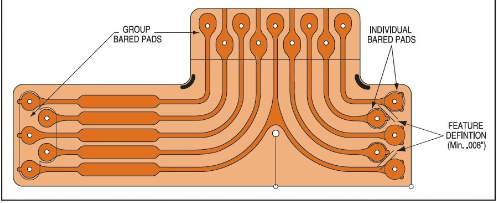
Figure 3. Flexible circuit with coverlayer. Image courtesy of Allflexinc.com.
Polyimide and adhesive coverlayers are laminated using pressure and heat, where the heat helps the adhesive flow easily and fill any gaps between traces and pads; this prevents air from being trapped between layers. Again from allflexinc.com: “Adhesive flow is necessary as it helps ensure complete surface contact and encapsulation. The adhesive will tend to ooze out slightly around the openings shown in the image below. This oozing out is often referred to as “adhesive squeeze out” and is actually a desirable phenomenon. “
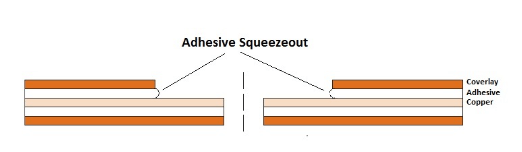
Figure 4. Flexible Circuit Coverlay Adhesive Extrusion. Image courtesy of Allflexinc.com.
After the coverlay lamination process is complete, use drilling, routing, or laser cutting to make any component and/or feature openings. Etching cannot be used.
IPC Standards for Rigid and Flexible PCBs
The following list of IPC standards applies to both rigid PCBs and flexible circuits. Please note that this list is not exhaustive and that additional IPC standards may need to be considered. You should visit the ipc.org website for a complete list of available IPC standards.
IPC-2221A, Printing General Standard for Brushed Circuit Board Design
IPC-2223, Standard for Design of Flexible Printed Circuit Boards
IPC-4101, Specification for Base Materials for Rigid and Multilayer Printed Circuit Boards
IPC-4202, Flexible Base Dielectrics for Flexible Printed Circuits
IPC-4203, Adhesive Coated Dielectric Films for Use as Cover Sheets for Flexible Printed Circuits and Flexible Adhesive Bonding Films
IPC-4204, Flexible Metal-Clad Dielectrics for Use in the Fabrication of Flexible Printed Circuits
IPC-6013, Qualification and Performance Specification for Flexible Printed Circuits
Conclusion
While both rigid and flexible printed circuit boards fundamentally serve the same purpose Both technologies have their place in life – connecting various electrical and mechanical components together. While many of the same design rules are used with rigid and flexible PCBs, flexible PCBs require some additional rules due to their additional manufacturing process steps. Although rigid PCBs may seem (at least initially) less costly, the total cost of ownership of a design should be considered before declaring flexible circuits too expensive.
Finally, it is important to note that not all board houses are capable of manufacturing flexible PCBs. Before beginning a flex circuit design, you should interview multiple board houses and discuss flexible PCB build options and associated costs.