
A history of City Construction in the Microcosm:Understanding PCB manufacturing in One Article
When we take apart a smartphone or computer,we often see a green board,studded with a dazzling array of electronic components in a dazzling array of shapes and lines.This board is the PCB known as the”mother of electronics”and the foundation of all electronic components.
You can imagine the PCB as a meticulously planned”micro-city”.copper foil traces are its”roads”responsible for transmitting signals and power,electronic components are the”buildling”located on both sides of the roads;and vias are the”overpass”connecting different levels of roads.Today,let’s take a look at the construction site of this mirco-city and see how it transforms from a simple insulating board into a powerful circuit carrier.
Phase 1:City Planning and Foundation-design and substrate Preparation
1.Circuit Design
Engineers use specialized software(such as Altium Designer,kiCad)to convert the circuit schematic(usually epoxy glass cltoh,codenamed FR-4) with copper foil covering one of both sides .This flat copper foil will be starting point for all future circuits.
The final output to the fabricator is a standardized drawing file called”Gerber”which precisely describes the pattern of each layer.
2.”Substrate Preparation”
The “foundation”of the city is material called”copper clad laminate.It consists of an isulating substrate(usually expoxy glass cloth,code named FR-4)with with copper foil covering one or both sides. This flat copper foil will be the starting point for all future circuits.
Phase 2: Main Road Construction – Pattern Transfer and Etching
This is the core step in PCB manufacturing, aiming to accurately replicate the circuitry on the design drawing onto the copper board.
- Pattern Transfer
- Cleaning the Copper Surface: First, thoroughly clean the copper-clad laminate to ensure the surface is spotless.
- Photoresist Coating: Apply an even layer of UV-sensitive photoresist to the copper surface.
- Exposure: Place a transparent film (similar to a negative) with the circuit pattern on it against the board and expose it to ultraviolet light. The light passes through the transparent portion, chemically changing (curing) the photoresist underneath, while the areas blocked by the circuit pattern remain unchanged.
- Development: Rinse the board with a chemical solution. Uncured photoresist is removed, revealing the copper underneath; the cured photoresist remains, forming a protective layer.
- Etching – “Carving Out” the Path
- The board is placed in an etching machine (usually using an acidic or alkaline solution). Copper not protected by the photoresist is completely etched away, while copper protected by the photoresist remains intact. * After etching is complete, the remaining photoresist is washed away, leaving only the copper traces required for our design on the board.
For double-sided and multi-layer boards, this process treats the inner and outer layers separately. For multi-layer boards, multiple inner core boards and prepreg (prepreg) are first stacked like a layered pancake, then pressed together under high temperature and high pressure to form a single unit.

Phase Three: Building Three-Dimensional Transportation – Drilling and Plating
It’s not enough to simply have circuits on the same plane; cities need overpasses to connect different layers.
- Drilling
- Using a precision drill or laser, small holes are drilled where needed to connect circuits on different layers or to mount components. These holes are categorized as:
- Component holes: For inserting component pins.
- Vias: Specifically used to connect circuits on different layers, serving as true “overpasses.”
- Hole Metallization – Making the “Overpass” Open to Traffic
- The drilled hole walls are insulated and cannot conduct electricity. At this point, a series of complex chemical processes (such as copper plating and electroplating) are required to deposit a thin layer of copper on the inner walls of the holes, electrically connecting the copper traces on different layers. This process is crucial to PCB reliability.
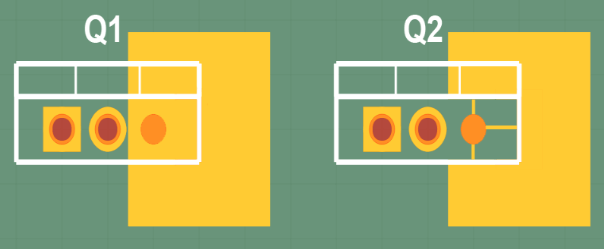
Phase 4: Urban Beautification and Protection – Solder Mask and Silkscreen
- Solder Mask – The City’s “Green Belt” and “Protective Clothing”
- The green (also available in blue, red, and black) coating we commonly see on PCBs is the Solder Mask.
- Its functions are:
- Preventing solder shorts: Windowing is only done where component pads are to be soldered, leaving all other areas covered to prevent solder from adhering to the circuitry during soldering.
- Protecting circuits: Protecting against moisture, corrosion, and scratches.
- Silkscreen – The City’s “Street Signs and House Numbers”
- Text, symbols, and component outlines are printed on the board using white (or other colored) ink. This is like labeling each “building” with a house number, making it easier for engineers to identify component location, model, and orientation. This is especially crucial during subsequent repairs and commissioning.
Phase 5: Final Refinement and Strict Acceptance – Surface Treatment and Testing
- Surface Treatment
- Exposed copper pads easily oxidize in air, rendering them unsolderable. Therefore, they require surface treatment. Common methods include:
- Halting: Low cost, good solderability, but with an uneven surface.
- Immersion Gold: Flat surface, strong oxidation resistance, suitable for miniaturization and high-density boards.
- Immersion Tin/Immersion Silver: Provides excellent solderability.
- Oxidation Superior Preservative: Creates a protective film on the copper surface, which is environmentally friendly and low-cost.
- Electrical Testing and Final Inspection
- Flying Probe Test/Fixture Test: Use probes to connect to test points, simulating actual circuit operation, to check whether all connections are smooth and whether there are any opens or shorts. This is a crucial step in ensuring every PCB leaving the factory is a quality product.
Automated Optical Inspection (AOI): A high-resolution camera scans the board, comparing it to the design drawings to check for defects such as missing circuits and short circuits.
After dozens of these precise and complex processes, a fully functional and reliable PCB is finally created! It will be shipped to the assembly plant, where it will receive its “residents”—a variety of electronic components. After soldering, it will eventually become the core of a living electronic device.
The next time you pick up an electronic device, imagine the magnificent epic of micro-city construction that unfolded within its tiny interior. PCB manufacturing is a perfect fusion of human ingenuity and precision engineering.