Design skills and key points for efficient automatic wiring of PCB
Although the current EDA tools are very powerful, as the PCB size requirements are getting smaller and smaller and the device density is getting higher and higher, the difficulty of PCB design is not small. How to achieve a high PCB routing rate and shorten the design time? This article introduces the design skills and key points of PCB planning, layout and routing. Now the time for PCB design is getting shorter and shorter, and the smaller circuit board space, higher and higher device density, extremely demanding layout rules and large-sized components make the designer’s work more difficult. In order to solve the design difficulties and speed up the launch of products, many manufacturers now tend to use dedicated EDA tools to implement PCB design. However, dedicated EDA tools cannot produce ideal results, nor can they achieve 100% routing rate, and they are very messy, and usually take a lot of time to complete the remaining work.
There are many popular EDA tool software on the market now, but they are similar except for the different terms used and the position of the function keys. How to use these tools to better implement PCB design? Careful analysis of the design before starting wiring and careful setting of the tool software will make the design more in line with the requirements. The following is the general design process and steps.
1.Determine the number of layers of the PCB
The size of the circuit board and the number of wiring layers need to be determined at the beginning of the design. If the design requires the use of high-density ball grid array (BGA) components, the minimum number of wiring layers required for the wiring of these devices must be considered. The number of wiring layers and the stack-up method will directly affect the wiring and impedance of the printed lines. The size of the board helps to determine the stack-up method and the width of the printed lines to achieve the desired design effect.
For many years, people have always believed that the fewer layers of the circuit board, the lower the cost, but there are many other factors that affect the manufacturing cost of the circuit board. In recent years, the cost difference between multi-layer boards has been greatly reduced. It is best to use more circuit layers and evenly distribute the copper at the beginning of the design to avoid finding that a small number of signals do not meet the defined rules and space requirements when the design is nearing the end, thus forcing new layers to be added. Careful planning before design will reduce a lot of trouble in wiring.
2.Design rules and restrictions
The automatic wiring tool itself does not know what to do. To complete the wiring task, the wiring tool needs to work under the correct rules and restrictions. Different signal lines have different routing requirements. All signal lines with special requirements should be classified. Different design classifications are also different. Each signal class should have a priority. The higher the priority, the stricter the rules. The rules involve printed line width, maximum number of vias, parallelism, mutual influence between signal lines, and layer restrictions. These rules have a great impact on the performance of routing tools. Careful consideration of design requirements is an important step in successful routing.
3.Component layout
To optimize the assembly process, design for manufacturability (DFM) rules will restrict component layout. If the assembly department allows component movement, the circuit can be properly optimized to facilitate automatic routing. The defined rules and constraints will affect the layout design.
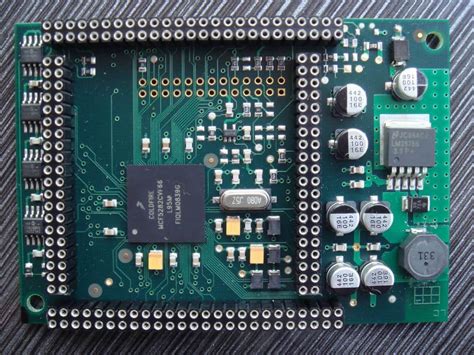
When laying out, consider the routing path (routing channel) and via area, as shown in the figure
. These paths and areas are obvious to designers, but automatic routing tools only consider one signal at a time. By setting routing constraints and setting the layers where signal lines can be routed, the routing tool can complete the routing as the designer envisions.
4.Fan-out design
During the fan-out design stage, in order for the automatic routing tool to connect the component pins, each pin of the surface mount device should have at least one via so that the circuit board can perform inner layer connections, online testing (ICT) and circuit reprocessing when more connections are needed.
In order to make the automatic routing tool most efficient, it is necessary to use the largest via size and printed wire as possible, and the spacing is set to 50mil. The via type that maximizes the number of routing paths should be used. When designing fan-out, consider the issue of circuit online testing. Test fixtures can be expensive and are usually ordered when full production is about to begin. If you consider adding nodes to achieve 100% testability at this time, it is too late.
After careful consideration and prediction, the design of circuit online testing can be carried out in the early stage of design and implemented in the later stage of the production process. The via fan-out type is determined based on the routing path and circuit online testing. Power supply and grounding will also affect the routing and fan-out design. To reduce the inductive reactance generated by the connection line of the filter capacitor, the via should be as close to the pin of the surface mount device as possible. Manual wiring can be used when necessary, which may affect the original wiring path and may even cause you to reconsider which via to use. Therefore, the relationship between the via and the pin inductive reactance must be considered and the priority of the via specification must be set.
5.Manual wiring and processing of key signals
Although this article mainly discusses the issue of automatic wiring, manual wiring is an important process in printed circuit board design now and in the future. Manual wiring helps automatic wiring tools complete the wiring work. As shown in Figures 2a and 2b, by manually wiring and fixing the selected network (net), a path that can be relied on for automatic wiring can be formed.
Regardless of the number of key signals, these signals are first routed, either manually or in combination with automatic wiring tools. Key signals usually require careful circuit design to achieve the desired performance. After the wiring is completed, the relevant engineering personnel will check the wiring of these signals, which is relatively easy. After the inspection, fix these lines and then start automatic wiring of the remaining signals.
6.Automatic routing
When routing key signals, it is necessary to consider controlling some electrical parameters during routing, such as reducing distributed inductance and EMC, and the routing of other signals is similar. All EDA vendors will provide a method to control these parameters. After understanding the input parameters of the automatic routing tool and the impact of the input parameters on routing, the quality of automatic routing can be guaranteed to a certain extent.
General rules should be used to automatically route signals. By setting restrictions and prohibited routing areas to limit the layers used by a given signal and the number of vias used, the routing tool can automatically route according to the engineer’s design ideas. If there is no restriction on the layers used by the automatic routing tool and the number of vias, each layer will be used during automatic routing, and many vias will be generated.
After setting the constraints and applying the created rules, the automatic routing will achieve results close to the expectations. Of course, some sorting work may be required, and space for other signal and network routing needs to be ensured. After a part of the design is completed, fix it to prevent it from being affected by the subsequent routing process.
The same steps are used to route the remaining signals. The number of routing times depends on the complexity of the circuit and the number of general rules you define. After each type of signal is completed, the constraints of the remaining network routing will be reduced. But what comes with it is that many signal routings require manual intervention. Today’s automatic routing tools are very powerful and can usually complete 100% of the routing. But when the automatic routing tool has not completed all signal routing, the remaining signals need to be manually routed.
7.The design points of automatic routing include:
7.1 Slightly change the settings and try multiple path routing;
7.2 Keep the basic rules unchanged, try different routing layers, different printed lines and spacing widths, and different line widths, different types of vias such as blind holes and buried holes, etc., and observe how these factors affect the design results;
7.3 Let the routing tool process those default networks as needed;
7.4 The less important the signal, the greater the freedom of the automatic routing tool to route it.
8.Arrangement of routing
If the EDA tool software you are using can list the routing lengths of the signals, check these data, you may find that the routing lengths of some signals with few constraints are very long. This problem is relatively easy to handle. Manual editing can shorten the signal wiring length and reduce the number of vias. During the sorting process, you need to determine which wiring is reasonable and which is unreasonable. Like manual wiring design, automatic wiring design can also be sorted and edited during the inspection process.
9.Appearance of the circuit board
Previous designs often paid attention to the visual effect of the circuit board, but now it is different. The automatically designed circuit board is not more beautiful than the manually designed one, but it can meet the specified requirements in terms of electronic characteristics, and the complete performance of the design is guaranteed.