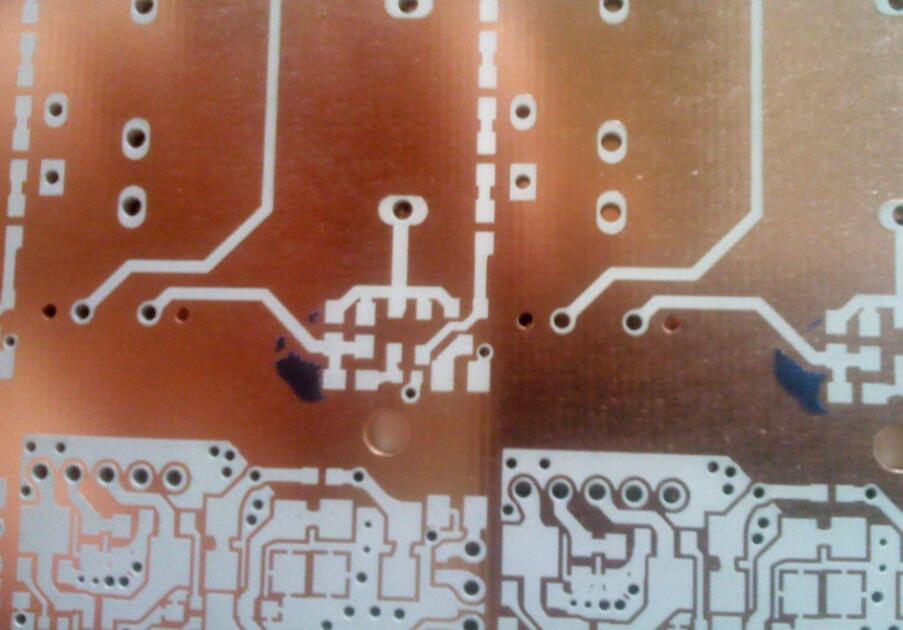
Etching process of PCB outer layer circuit
I. Overview
At present, the typical process of printed circuit board (PCB) processing adopts “graphic electroplating method”. That is, a lead-tin anti-corrosion layer is pre-plated on the copper foil part of the outer layer of the board to be retained, that is, the graphic part of the circuit, and then the rest of the copper foil is corroded by chemical means, which is called etching.
It should be noted that there are two layers of copper on the board at this time. In the outer layer etching process, only one layer of copper must be completely etched away, and the rest will form the final required circuit. This type of graphic electroplating is characterized by the copper plating layer only existing under the lead-tin anti-corrosion layer. Another process method is to plate copper on the entire board, and the part outside the photosensitive film is only tin or lead-tin anti-corrosion layer. This process is called “full board copper plating process”. Compared with graphic electroplating, the biggest disadvantage of full board copper plating is that copper must be plated twice everywhere on the board surface and they must be corroded away during etching. Therefore, when the wire width is very fine, a series of problems will arise. At the same time, side corrosion will seriously affect the uniformity of the line.
In the processing technology of the outer layer circuit of the printed circuit board, there is another method, which is to use a photosensitive film instead of a metal plating layer as an anti-corrosion layer. This method is very similar to the inner layer etching process, and you can refer to the etching in the inner layer manufacturing process.
At present, tin or lead tin is the most commonly used anti-corrosion layer, which is used in the etching process of ammonia etchants. Ammonia etchants are commonly used chemical liquids and do not react chemically with tin or lead tin. Ammonia etchants mainly refer to ammonia water/ammonia chloride etching liquid. In addition, ammonia water/ammonia sulfate etching liquid can also be purchased on the market.
After using the sulfate-based etching liquid, the copper in it can be separated by electrolysis, so it can be reused. Because of its low corrosion rate, it is generally rare in actual production, but it is expected to be used in chlorine-free etching. Some people have tried to use sulfuric acid-hydrogen peroxide as an etchant to corrode the outer layer pattern. Due to many reasons, including economic and waste liquid treatment, this process has not been widely adopted in a commercial sense. Furthermore, sulfuric acid-hydrogen peroxide cannot be used for etching of lead-tin anti-corrosion layers, and this process is not the main method in the production of PCB outer layers, so most people rarely ask about it.
2.Etching quality and previous problems
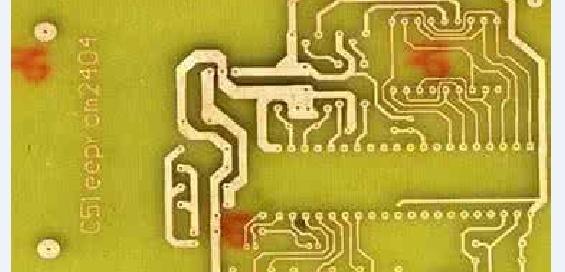
The basic requirement for etching quality is to be able to completely remove all copper layers except under the anti-corrosion layer, and that’s it. Strictly speaking, if you want to define it accurately, then the etching quality must include the consistency of the wire width and the degree of side etching. Due to the inherent characteristics of the current etching solution, it not only etches downward but also in all directions, so side etching is almost inevitable.
The side etching problem is a frequently discussed item in the etching parameters. It is defined as the ratio of the side etching width to the etching depth, called the etching factor. In the printed circuit industry, it varies widely, from 1:1 to 1:5. Obviously, a small side etching degree or a low etching factor is the most satisfactory.
The structure of the etching equipment and the etching solution of different components will affect the etching factor or side etching degree, or in optimistic terms, it can be controlled. The use of certain additives can reduce the side etching degree. The chemical composition of these additives is generally a trade secret, and the respective developers do not disclose it to the outside world. As for the structural problems of the etching equipment, the following chapters will discuss them specifically.
In many ways, the quality of etching has existed long before the printed circuit board enters the etching machine. Because there is a very close internal connection between the various processes or processes of printed circuit processing, there is no process that is not affected by other processes and does not affect other processes. Many problems that are considered to be etching quality actually exist in the film removal or even earlier processes. For the etching process of the outer layer graphics, because the “reverse stream” phenomenon it embodies is more prominent than most printed circuit board processes, many problems are finally reflected on it. At the same time, this is also because etching is the last link in a long series of processes starting from self-adhesion and photosensitive, after which the outer layer graphics are successfully transferred. The more links there are, the greater the possibility of problems. This can be regarded as a very special aspect of the printed circuit production process.
Theoretically, after the printed circuit enters the etching stage, in the process of processing the printed circuit by the graphic electroplating method, the ideal state should be: the sum of the thickness of the copper and tin or copper and lead-tin after electroplating should not exceed the thickness of the electroplating-resistant photosensitive film, so that the electroplating pattern is completely blocked by the “walls” on both sides of the film and embedded in it. However, in actual production, the plating pattern of printed circuit boards around the world is much thicker than the photosensitive pattern after electroplating. In the process of electroplating copper and lead-tin, since the height of the plating exceeds the photosensitive film, a tendency of lateral accumulation occurs, and the problem arises. The tin or lead-tin anti-corrosion layer covering the line extends to both sides to form an “edge”, covering a small part of the photosensitive film under the “edge”.
The “edge” formed by tin or lead-tin makes it impossible to completely remove the photosensitive film when removing the film, leaving a small part of the “residual glue” under the “edge”. The “residual glue” or “residual film” left under the “edge” of the resist will cause incomplete etching. After etching, “copper roots” are formed on both sides of the lines. The copper roots narrow the line spacing, causing the printed board to fail to meet the requirements of Party A and may even be rejected. Rejection will greatly increase the production cost of the PCB.
In addition, in many cases, due to the reaction, the dissolution is formed. In the printed circuit industry, the residual film and copper may also accumulate in the etching liquid and block the nozzle of the etching machine and the acid-resistant pump. The machine has to be stopped for processing and cleaning, which affects the work efficiency.
3.Equipment adjustment and interaction with the etching solution
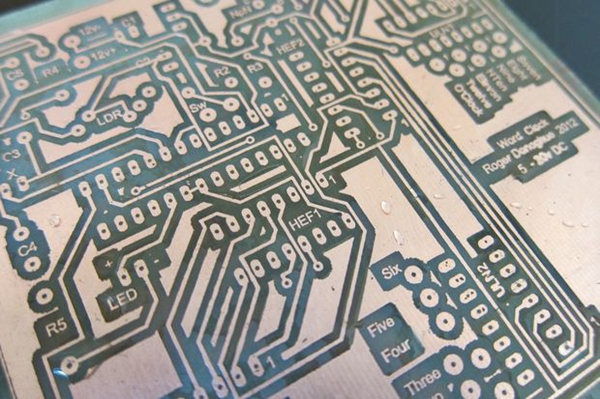
In printed circuit processing, ammonia etching is a more delicate and complex chemical reaction process. On the other hand, it is an easy-to-carry job. Once the process is adjusted, continuous production can be carried out. The key is that once the machine is turned on, it must maintain a continuous working state and should not be stopped and started. The etching process depends to a great extent on the good working condition of the equipment. At present, no matter what kind of etching solution is used, high-pressure spraying must be used, and in order to obtain a neater line side and high-quality etching effect, the nozzle structure and spraying method must be strictly selected.
In order to obtain good side effects, many different theories have emerged, forming different design methods and equipment structures. These theories are often very different. However, all theories related to etching recognize such a basic principle, that is, to keep the metal surface in contact with fresh etching solution as quickly as possible. The chemical mechanism analysis of the etching process also confirms the above view. In ammonia etching, assuming that all other parameters remain unchanged, the etching rate is mainly determined by the ammonia (NH3) in the etching solution. Therefore, the use of fresh solution to react with the etching surface has two main purposes: one is to wash away the copper ions that have just been produced; the other is to continuously provide the ammonia (NH3) required for the reaction.
In the traditional knowledge of the printed circuit industry, especially the suppliers of printed circuit raw materials, it is generally recognized that the lower the content of monovalent copper ions in ammonia etching solution, the faster the reaction rate. This has been confirmed by experience. In fact, many ammonia etching solution products contain special ligands for monovalent copper ions (some complex solvents), whose function is to reduce monovalent copper ions (these are the technical secrets of their products with high reactivity). It can be seen that the influence of monovalent copper ions is not small. Reducing the monovalent copper from 5000ppm to 50ppm will more than double the etching rate.
Because a large amount of monovalent copper ions are generated during the etching reaction, and because monovalent copper ions are always tightly bound to the complex base of ammonia, it is very difficult to keep their content close to zero. Monovalent copper can be removed by converting it into divalent copper through the action of oxygen in the atmosphere. This can be achieved by spraying.
This is a functional reason for passing air into the etching box. However, if there is too much air, it will accelerate the loss of ammonia in the solution and reduce the pH value, which will still reduce the etching rate. Ammonia in the solution is also a variable amount that needs to be controlled. Some users adopt the practice of passing pure ammonia into the etching reservoir. This requires a pH meter control system. When the automatically measured pH result is lower than the given value, the solution will be automatically added.
In the related field of chemical etching (also known as photochemical etching or PCH), research work has begun and has reached the stage of etching machine structure design. In this method, the solution used is divalent copper, not ammonia-copper etching. It will likely be used in the printed circuit industry. In the PCH industry, the typical thickness of etched copper foil is 5 to 10 mils, and in some cases the thickness is quite large. The requirements for etching parameters are often more stringent than in the PCB industry.
There is a research result from the PCM industrial system that has not yet been officially published, but the results will be refreshing. With the support of a relatively strong project fund, researchers have the ability to change the design ideas of etching equipment in a long-term sense and study the effects of these changes. For example, compared with the conical nozzle, the best nozzle design adopts a fan shape, and the spray manifold (that is, the section of the pipe that the nozzle is screwed into) also has an installation angle that can spray the workpiece entering the etching chamber at 30 degrees. If such a change is not made, the installation method of the nozzle on the manifold will result in the spray angle of each adjacent nozzle not being completely consistent. The spray surface of each of the second group of nozzles is slightly different from that of the first group (it represents the working condition of the spray). This makes the shape of the sprayed solution superimposed or crossed. Theoretically, if the solution shapes intersect each other, the jet force of that part will be reduced, and the old solution on the etching surface cannot be effectively washed away while the new solution is in contact with it. This situation is particularly prominent at the edge of the spray surface. Its jet force is much smaller than that in the vertical direction.
This study found that the latest design parameter is 65 pounds per square inch (i.e. 4+Bar). Every etching process and every practical solution has an optimal jet pressure problem, and at present, the situation where the jet pressure in the etching chamber reaches more than 30 pounds per square inch (2Bar) is very rare. There is a principle that the higher the density (i.e. specific gravity or Baume) of an etching solution, the higher the optimal jet pressure should be. Of course, this is not a single parameter. Another important parameter is the relative mobility (or mobility) that controls its reaction rate in the solution.

4.Regarding the different etching states of the upper and lower boards, the lead-in edge and the rear-in edge
A large number of problems involving etching quality are concentrated on the etched part on the upper board surface. It is very important to understand this. These problems come from the influence of the gelatinous plate aggregates produced by the etchant on the upper board surface of the printed circuit board. The accumulation of colloidal agglomerates on the copper surface affects the jet force on the one hand, and blocks the replenishment of fresh etching solution on the other hand, resulting in a decrease in etching speed. It is precisely because of the formation and accumulation of colloidal agglomerates that the etching degree of the upper and lower patterns of the board is different. This also makes it easy for the first part of the board to be etched thoroughly or easily cause over-corrosion in the etching machine, because the accumulation has not yet formed at that time, and the etching speed is faster. On the contrary, the accumulation has already formed when the part of the board that enters later enters, and its etching speed is slowed down.
5.Maintenance of etching equipment
The most critical factor in the maintenance of etching equipment is to ensure that the nozzle is clean and there is no obstruction to make the jet unobstructed. Obstructions or slag will impact the layout under the action of the jet pressure. If the nozzle is not clean, it will cause uneven etching and make the entire PCB scrapped.
Obviously, the maintenance of the equipment is to replace damaged and worn parts, including replacing the nozzle, and the nozzle also has the problem of wear. In addition, the more critical issue is to keep the etching machine free of slag, which will accumulate in many cases. Excessive slag accumulation may even affect the chemical balance of the etching solution. Similarly, if the etching solution has excessive chemical imbalance, slagging will become more serious. The problem of slagging accumulation cannot be overemphasized. Once the etching solution suddenly has a large amount of slagging, it is usually a signal that there is a problem with the balance of the solution. This should be properly cleaned with stronger hydrochloric acid or the solution should be replenished.
Residual film can also produce slagging. A very small amount of residual film dissolves in the etching solution and then forms copper salt precipitation. The slagging formed by the residual film indicates that the previous film removal process is not thorough. Poor film removal is often the result of edge film and over-plating.