Flexible pcb elements
1. Flexible circuits – These are circuits that are made using thin, flexible materials and are often used in applications such as medical devices, aerospace, and automotive electronics.
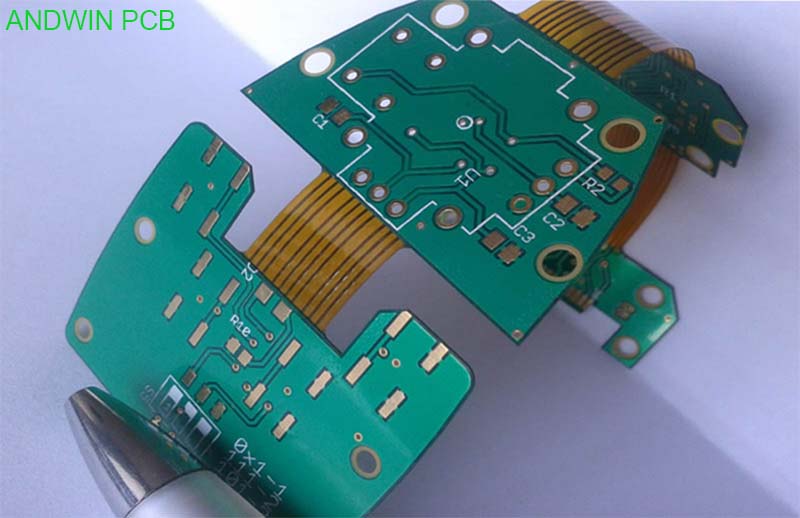
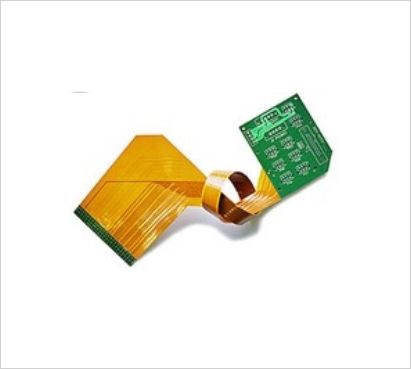
2. Flex-rigid circuits – These are circuits that combine both flexible and rigid materials to create a circuit that can bend and twist in certain areas while remaining rigid in others.
3. Flexible heaters – These are circuits that are designed to generate heat and are often used in applications such as medical devices, aerospace, and industrial equipment.
4. Flexible sensors – These are circuits that are designed to detect changes in temperature, pressure, or other environmental factors and are often used in medical devices, automotive electronics, and consumer electronics.
Overall, flexible PCB elements offer a range of benefits over traditional rigid circuits, including increased flexibility, reduced weight and size, and improved durability and reliability.
Patents issued at the turn of the 20th century show interest in flat electrical conductors sandwiched between layers of insulating material.
The resulting electrical circuits were to serve in early telephony switching applications.
One of the earliest descriptions of what could be called a flex circuit was unearthed by Dr Ken Gilleo and disclosed in a 1903 English patent by Albert Hansen that described a construction consisting of flat metal conductors on paraffin coated paper.
Thomas Edison’s lab books from the period indicate that he was thinking to coat cellulose gum applied to linen paper with graphite powder to create what would have clearly been flexible circuits,
though no evidence indicates that it was reduced to practice.
The 1947 publication “Printed Circuit Techniques” by Brunetti and Curtis a brief discussion of creating circuits on what would have been flexible insulating materials (e.g. paper).
In the 1950s Dahlgren and Sanders made significant strides developing and patenting processes for printing and etching flat conductors on flexible base materials to replace wire harnesses.
An advertisement from the 1950s placed by Photocircuits Corporation demonstrated their interest in flexible circuits.
Flexible circuits are variously known around the world variously as flexible printed wiring, flex print, flexi circuits, are used in many products.
Credit is due to the efforts of Japanese electronics packaging engineers who have found ways to employ flexible circuit technology.
Flexible circuits are one of the fastest growing interconnection product market segments.
One variation on flexible circuit technology is called “flexible electronics”.
It involves the integration of both active and passive functions in the device.
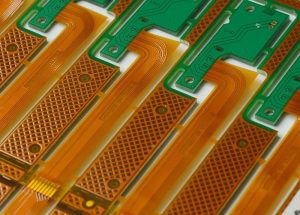
Flexible PCB elements are electronic circuits that are made using flexible materials such as polyimide or polyester.
These flexible materials allow the circuit to bend and twist without breaking,
making them ideal for use in applications where space is limited or where the circuit needs to be able to move.
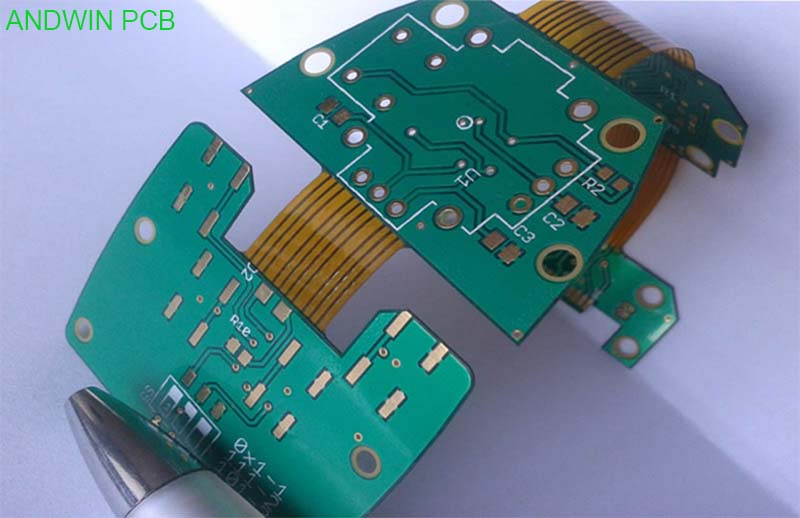
flexible pcb examples
1. Wearable Technology:
Flexible PCBs are used in wearable technology such as smartwatches, fitness trackers, and health monitors.
The flexible nature of the PCB allows it to be easily integrated into clothing or accessories.
2. Automotive Industry:
Flexible PCBs are used in the automotive industry for various applications such as dashboard displays,
lighting systems, and sensors. The flexible nature of the PCB allows it to be easily integrated into the complex shapes and spaces of a vehicle.
3. Medical Devices:
Flexible PCBs are used in medical devices such as pacemakers, defibrillators, and insulin pumps.
The flexibility of the PCB allows it to be easily integrated into the small and complex shapes of medical devices.
4. Aerospace Industry:
Flexible PCBs are used in the aerospace industry for various applications such as communication systems,
navigation systems, and control systems.
The flexible nature of the PCB allows it to be easily integrated into the complex shapes and spaces of an aircraft.
5. Consumer Electronics: Flexible PCBs are used in consumer electronics such as smartphones, tablets, and laptops.
The flexible nature of the PCB allows it to be easily integrated into the slim and compact designs of these devices.