How to Reduce Noise in MLCCs for Power Applications
Abstract
Multilayer ceramic capacitors (MLCCs) are widely used in power electronics for decoupling, filtering, and energy storage applications. However, these components can generate significant acoustic noise and electrical noise under certain operating conditions, which may affect system performance and reliability. This paper examines the root causes of MLCC noise in power applications and provides comprehensive solutions to mitigate both acoustic and electrical noise. We discuss material selection, circuit design techniques, layout considerations, and advanced filtering methods to minimize noise in MLCC implementations.
1. Introduction
Multilayer ceramic capacitors have become essential components in modern power electronics due to their high capacitance density, low equivalent series resistance (ESR), and excellent high-frequency characteristics. However, two primary types of noise phenomena associated with MLCCs have emerged as significant concerns for designers:
- Acoustic Noise (Audible Buzz): Piezoelectric effects in ceramic dielectrics causing physical vibrations
- Electrical Noise: Unwanted voltage/current fluctuations affecting signal integrity
These noise issues become particularly pronounced in power applications where MLCCs experience high ripple currents, rapid voltage transitions, or significant temperature variations. Left unaddressed, these noise sources can lead to:
- Reduced power supply quality
- Electromagnetic interference (EMI) problems
- Signal integrity issues in sensitive circuits
- Audible noise complaints in consumer products
- Potential long-term reliability concerns
This paper provides practical solutions organized into four main categories: material and component selection, circuit design techniques, PCB layout strategies, and advanced filtering methods.
2. Understanding MLCC Noise Mechanisms
2.1 Acoustic Noise Generation
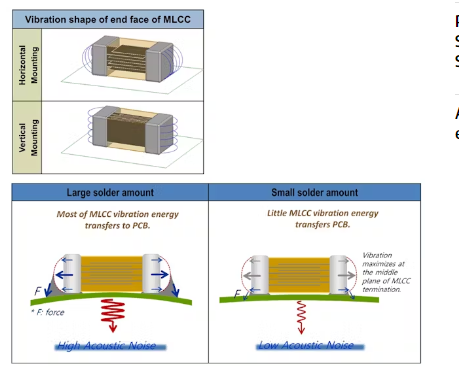
The piezoelectric properties of barium titanate (BaTiO₃), the most common dielectric material in high-capacitance MLCCs, are responsible for acoustic noise generation. When alternating voltages are applied, the ceramic material physically expands and contracts due to the inverse piezoelectric effect. Key factors influencing acoustic noise include:
- Voltage amplitude and frequency: Higher voltages and frequencies in the audible range (20Hz-20kHz) produce more noticeable noise
- Capacitor size: Larger case sizes (e.g., 1210, 1812) generate more audible noise than smaller packages
- Mounting conditions: Board stiffness and mechanical damping affect noise transmission
2.2 Electrical Noise Generation
Electrical noise in MLCCs manifests as unwanted voltage/current fluctuations and can originate from several mechanisms:
- Nonlinear capacitance: The Class II (X7R, X5R) and Class III (Y5V) dielectrics exhibit voltage-dependent capacitance
- Microphonics: Mechanical vibrations modulating the capacitance value
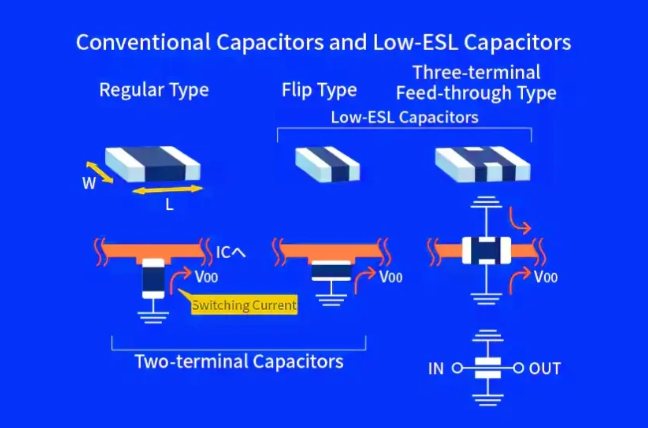
- Parasitic effects: Equivalent series inductance (ESL) and resistance (ESR) creating impedance spikes
- Temperature effects: Dielectric properties changing with temperature
3. Material and Component Selection Strategies
3.1 Dielectric Material Selection
Choosing the appropriate dielectric material is the first line of defense against MLCC noise:
- For lowest acoustic noise:
- Consider Class I (C0G/NP0) dielectrics which are non-piezoelectric
- When Class I isn’t feasible due to capacitance requirements, use “soft” Class II formulations specifically designed for low noise
- For stable electrical characteristics:
- Prefer X7R over X5R or Y5V for better voltage and temperature stability
- Consider high-voltage rated parts (e.g., 100V rated for 50V applications) to reduce voltage coefficient effects
3.2 Package Size and Construction
- Use smaller case sizes (0402, 0603) when possible to reduce acoustic noise
- Consider reverse geometry MLCCs (length > width) for reduced ESL and better high-frequency performance
- Evaluate stacked or array configurations to distribute current and reduce vibration
3.3 Alternative Capacitor Technologies
For extremely noise-sensitive applications:
- Consider hybrid solutions combining MLCCs with:
- Tantalum capacitors (stable capacitance but higher ESR)
- Aluminum electrolytics (for bulk decoupling)
- Film capacitors (for critical filtering stages)
4. Circuit Design Techniques
4.1 Voltage Derating
- Operate MLCCs at 50-70% of rated voltage to minimize piezoelectric effects and capacitance variation
- Implement voltage dividers or regulators to reduce voltage stress on decoupling capacitors
4.2 Frequency Management
- Avoid operating at resonant frequencies of the MLCC (typically 1-10MHz for small packages)
- Spread spectrum techniques can help distribute acoustic energy
- For switching converters, consider frequencies above 20kHz to move noise out of audible range
4.3 Balanced Circuit Approaches
- Use back-to-back MLCC configurations for AC applications:
- Two identical MLCCs connected in series with opposite polarization
- Cancels out net piezoelectric strain while maintaining capacitance
4.4 Current Limiting and Impedance Matching
- Add small resistors (0.5-2Ω) in series with MLCCs to limit surge currents
- Properly match source and load impedances to minimize reflections
5. PCB Layout Strategies
5.1 Mechanical Damping Techniques
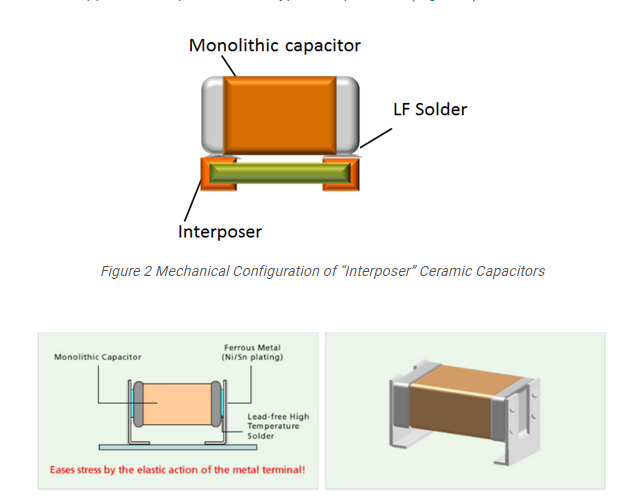
- Use flexible solder masks or damping materials under capacitors
- Implement board stiffeners in areas with high capacitor concentration
- Consider strategic placement near board supports to reduce vibration
5.2 Optimal Placement
- Place high-current MLCCs close to power pins of ICs
- Distribute multiple small capacitors rather than using one large capacitor
- Avoid placing noise-sensitive components near high-ripple current MLCCs
5.3 Routing Considerations
- Minimize loop areas to reduce magnetic field coupling
- Use symmetric routing for differential pairs
- Implement proper ground planes to provide low-impedance return paths
6. Advanced Filtering Methods
6.1 Active Cancellation Techniques
- Implement active noise cancellation circuits using op-amps to inject anti-phase signals
- Use feedforward control in switching converters to preemptively compensate for ripple
6.2 Multi-stage Filtering
- Combine MLCCs with other filter types:
- LC filters for broadband attenuation
- RC filters for targeted frequency ranges
- Ferrite beads for high-frequency noise suppression
6.3 Digital Signal Processing
- For measurable but predictable noise patterns:
- Implement digital filtering algorithms
- Use adaptive filtering techniques that can track and cancel noise
7. Measurement and Verification
Proper measurement techniques are essential for evaluating noise reduction effectiveness:
- Acoustic Noise Measurement:
- Use calibrated microphones in anechoic chambers
- Near-field measurements for component-level characterization
- Electrical Noise Measurement:
- High-bandwidth oscilloscopes with proper probing techniques
- Spectrum analyzers for frequency-domain analysis
- Low-inductance measurement setups to avoid artifacts
- Vibration Analysis:
- Laser Doppler vibrometers for non-contact measurement
- Accelerometers for board-level vibration profiling
8. Case Studies and Practical Examples
8.1 Switching Power Supply Example
A 500kHz buck converter was producing audible noise from its 10μF output MLCC. Solutions implemented:
- Replaced single 1210 package with three 0603 parts in parallel
- Added 1Ω series resistance to each capacitor
- Adjusted switching frequency to 525kHz to move away from mechanical resonance
- Result: 15dB reduction in audible noise
8.2 Audio Circuit Example
A high-end DAC was experiencing signal distortion from decoupling capacitor microphonics:
- Switched from X7R to C0G dielectrics for critical bypass caps
- Implemented balanced back-to-back configuration for bulk decoupling
- Added conformal coating for mechanical damping
- Result: THD+N improved from 0.015% to 0.005%
9. Future Trends and Developments
Emerging technologies that may further reduce MLCC noise:
- New Dielectric Materials:
- Modified barium titanate formulations with reduced piezoelectricity
- Alternative perovskite materials with stable characteristics
- Advanced Packaging:
- Embedded capacitor technology reducing mechanical vibration
- 3D capacitor structures with improved mechanical stability
- Active Components:
- Integrated active cancellation circuits within capacitor packages
- Smart capacitors with built-in noise monitoring and compensation
10. Conclusion
Reducing noise in MLCCs for power applications requires a multifaceted approach addressing both acoustic and electrical noise sources. Key takeaways include:
- Proper component selection (dielectric type, package size, voltage rating) forms the foundation of noise reduction
- Circuit design techniques (derating, frequency management, balanced configurations) can significantly mitigate noise
- Careful PCB layout (mechanical damping, optimal placement, proper routing) prevents noise coupling
- Advanced filtering methods (active cancellation, multi-stage filters) provide additional noise suppression