PCB Heat Dissipation Techniques: Effective Strategies for Thermal Management
Introduction
Printed Circuit Boards (PCBs) are the backbone of modern electronic devices, from consumer electronics to industrial machinery. As electronic components become more powerful and compact, managing heat dissipation has become a critical challenge. Excessive heat can lead to component failure, reduced performance, and shorter product lifespans. Therefore, effective thermal management is essential for ensuring reliability and longevity.
This article explores various PCB heat dissipation techniques, including material selection, layout optimization, active and passive cooling methods, and advanced thermal management solutions.
1. Importance of Thermal Management in PCBs
Heat is an inevitable byproduct of electronic components, especially high-power devices like CPUs, GPUs, and power transistors. Poor thermal management can cause:
- Component Degradation: Excessive heat accelerates wear and tear, reducing component lifespan.
- Performance Throttling: Many devices reduce performance to prevent overheating, leading to slower operation.
- Thermal Runaway: In extreme cases, heat buildup can cause catastrophic failure or even fires.
Thus, engineers must implement effective heat dissipation strategies during PCB design.
2. PCB Material Selection for Better Heat Dissipation
2.1 High-Thermal-Conductivity Substrates
The base material of a PCB plays a crucial role in heat dissipation. Common materials include:
- FR-4: Standard material with low thermal conductivity (~0.3 W/mK). Suitable for low-power applications.
- Metal-Core PCBs (MCPCBs): Use aluminum or copper cores (thermal conductivity: 200-400 W/mK) to efficiently transfer heat away from components.
- Ceramic Substrates (AlN, BeO): Offer excellent thermal conductivity (170-300 W/mK) but are expensive and used in high-performance applications.
2.2 Thermal Vias
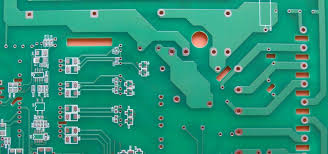
Thermal vias are plated holes that transfer heat from surface components to inner layers or heat sinks. They improve heat dissipation by:
- Connecting hot components to internal copper planes.
- Enhancing heat spreading across the PCB.
2.3 Copper Pour and Heat Spreaders
Increasing copper thickness in power and ground planes improves heat distribution. Additionally, embedded heat spreaders (copper or graphite) help dissipate heat more efficiently.
3. PCB Layout Optimization for Heat Management
3.1 Component Placement
- Separate High-Power Components: Place heat-generating components (e.g., voltage regulators, power ICs) away from temperature-sensitive parts.
- Uniform Heat Distribution: Avoid clustering high-power devices in one area to prevent localized overheating.
3.2 Trace Width and Thickness
- Wider and thicker traces reduce resistance and heat generation in high-current paths.
- Use copper weight (e.g., 2 oz/ft² instead of 1 oz/ft²) for better heat dissipation.
3.3 Thermal Relief Pads
Thermal relief pads prevent excessive heat transfer during soldering while maintaining electrical connectivity. They help balance heat dissipation and manufacturability.
4. Passive Cooling Techniques
Passive cooling methods do not require external power and are widely used in PCB designs.
4.1 Heat Sinks
- Attached to high-power components (e.g., MOSFETs, CPUs) to increase surface area for heat dissipation.
- Materials: Aluminum (lightweight, cost-effective) or copper (higher thermal conductivity).
4.2 Thermal Pads and Pastes
- Thermal Interface Materials (TIMs) fill microscopic gaps between components and heat sinks, improving heat transfer.
- Graphite pads offer excellent thermal conductivity and electrical insulation.
4.3 Natural Convection and Radiation
- Ventilation Holes: Allow hot air to escape and cool air to enter.
- Dark-colored PCBs: Emit heat more efficiently through radiation (though less significant than conduction/convection).
5. Active Cooling Techniques
Active cooling methods use external power to enhance heat dissipation.
5.1 Fans and Blowers
- Common in computers, power supplies, and industrial electronics.
- Axial fans provide airflow parallel to the PCB, while blower fans direct air perpendicularly.
5.2 Liquid Cooling
- Used in high-performance systems (e.g., gaming PCs, servers).
- Cold plates transfer heat to a liquid coolant, which is then circulated and cooled externally.
5.3 Thermoelectric Coolers (Peltier Devices)
- Use the Peltier effect to actively transfer heat from one side to another.
- Effective for localized cooling but require significant power.
6. Advanced PCB Heat Dissipation Techniques
6.1 Phase-Change Materials (PCMs)
- Absorb heat by changing state (e.g., solid to liquid) and release it when cooling.
- Useful in applications with intermittent high heat loads.
6.2 Heat Pipes
- Highly efficient two-phase heat transfer devices.
- Transfer heat from hotspots to cooler areas or external heat sinks.
6.3 Embedded Cooling Channels
- Microfluidic channels circulate coolant within the PCB.
- Emerging technology for ultra-high-power applications.
7. Simulation and Testing for Thermal Management
7.1 Thermal Simulation Software
- Tools like ANSYS Icepak, SolidWorks Flow Simulation, and Altium Designer’s thermal analysis help predict heat distribution before manufacturing.
7.2 Infrared Thermography
- Identifies hotspots in real-world testing.
- Helps validate thermal design improvements.
7.3 Thermal Cycling Tests
- Simulate operating conditions to ensure long-term reliability.
8. Case Study: Effective Heat Dissipation in a Power Supply PCB
A 500W power supply PCB was experiencing overheating in its MOSFETs. The following changes were implemented:
- Upgraded to an MCPCB with an aluminum core.
- Added thermal vias beneath the MOSFETs.
- Installed heat sinks with thermal paste.
- Optimized component placement to distribute heat evenly.
Result: Temperature dropped by 25°C, significantly improving reliability.
9. Future Trends in PCB Thermal Management
- 3D-Printed Heat Sinks: Custom designs for optimized cooling.
- Nanomaterials: Graphene-enhanced substrates for ultra-high conductivity.
- AI-Driven Thermal Optimization: Machine learning algorithms for predictive cooling solutions.
10. Conclusion
Effective PCB heat dissipation is crucial for performance, reliability, and safety. By combining material selection, layout optimization, passive/active cooling, and advanced techniques, engineers can mitigate thermal issues in modern electronics. As technology advances, innovative solutions like embedded cooling and nanomaterials will further enhance thermal management in PCBs.
By implementing these strategies, designers can ensure their PCBs operate efficiently even under demanding thermal conditions.