PCB Recipe:Understanding the Ubiquitous BOM
Imagine you’re baking a beautiful cake,you ‘ll need a recipe detailing the types,quantities,and steps for all the ingredients,such as flour,eggs,sugar,and butter,Similarly,when manufacturing a printed circuit board(PCB),which is ubiquitous in our lives ,engineers also need a precise:”recipe”-this recipe is the”Bill of Materials,or BOM”
Today,let’s unveil the mystery of the mystery of the PCB BOM and see how this seemingly dry list becomes the”lifeline”of electronic product manufacturing.
1.What is a PCB BOM?
Bom(short for Bill of Materials) is a document in PCB design and manufacturing that details all the components,meterials,and quantities required to assemble a circuit board.
IF the PCB design drawing(Gerber file)is the “architectural blueprint”of the circuit board,defining the placement of components and electrical connections,then the BOM is the “procurement list”and “assembly guide”for that blueprint.Without a Bill of Materials(BOM),even with the most perfect design,a factory cannot know what to buy or use to transform a blank circuit board into a powerful core component.
2.What information Does a BOM contain?
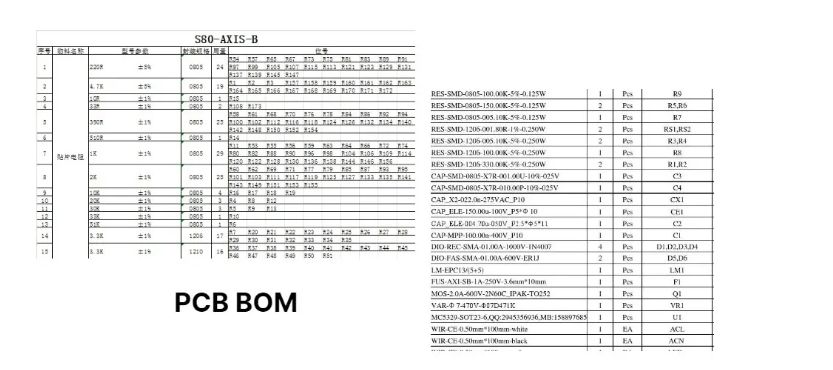
A professional PCB BOM is far more than just a list of part name.It’s typically a well-structures table containing the follwing core information:
(1)Item/Serial Number:A unique number assigned to each component for easy searching and tracking.
(2)Component Name/Description:A simple description of the component,such as”100uF 16V electrolytic capacitor”or STM32F103C8T6 microcontroller.
(3)Component Model/Part Number:This is the“most critical”information;it is the component unique “identity card”with the manufacture.For example,GRM21BR61A226ME44L (Murata capacitor model). The model number must be absolutely accurate; even a slight difference can render the entire board unusable.
(4)Package:Describe the physical form and pad size of the component on the PCB, such as”0805″(Resistor/capacitor package)or QFP-48(Chip package).It ensures the component can be soldered precisely to the correct location.
(5)Component Designation: Corresponds one-to-one with the markings on the PCB design drawing such as “R1,R2,C5,U3″It tells the assembly worker’which part should be placed where.
(6)Quantity:The number of this component required per circuit board.This is the direct basis for calculating costs and procurement quantities.
(7)Supper/Manufacturer:Recommended or specified component sources.This helps ensure consistent quality and stable supply.
(8)Remark:Some special requirements,such as “specific brand only.””lead-free process requirement””alternative material information”etc.

3.Why is the BOM so important?The value of a Bill of material(BOM)is present throughout the entire product lifecycle:
In the design phase:It summarizes the engineers’selection,aiding in cost estimation and feasibility analysis .
In the procurement phase:The procurement department uses the BOM to request quotes from suppliers and place orders,ensuring the correct materials are purchased.An incorrect BOM can lead to the purchase of a large number of faulty components,resulting in significant economic losses.
In the production phase:The production line uses the BOM to requisition and prepare material,and SMT Placement machines and operators perform precise assembly based on the Component identification information in the BOM.
In the testing and repair phase:Repair personal use the component identification numbers and model numbers in the BOM to quickly locate and replace faulty components.
In the product lifecycle management phase:When a component is discontinued (EOL),the BOM is used to quickly locate affected products and find alternative solutions.
In short,the accuracy of the BOM directly determines the success or failure of product manufacturing.”Garbage in ,garbage out”-if the BOM is wrong,the manufactured product will inevitably be wong as well.
4.Pitfalls and challenges of BOM
Creating and maintaining a perfect BOM is no easy task.Common challenges include:
Incorrect or Incomplete information:Incorrect model numbers,mismatched reference numerals,incorrect package designs,etc,are the most common and fatal problems.
Component Discontinuation or Shortage:The electronic component market changes rapidly.A critical chip in the BOM may suddenly be discontinued,causing production interruptions .
Disorganized Alternative Material management:A component may have alternative materials from multiple suppliers.If this not clearly indicated in the BOM, it may lead to inconsistencies in materials used in different batches,affecting performance consistency.
- Uncontrolled Version Management: Multiple versions of the BOM may be generated during product design iterations. If the factory uses an incorrect version of the BOM for production, the consequences are unimaginable.
5. How to Create a Good BOM?
- Meticulous Verification: Before release, the BOM must be repeatedly verified by design engineers, hardware managers, and other stakeholders to ensure that every piece of information is consistent with the design documents.
- Use Professional Tools: Utilize professional EDA (Electronic Design Automation) software or PLM (Product Lifecycle Management) systems to generate and manage the BOM (Bill of Materials). These tools automatically extract information from schematics, reducing errors from manual input.
- Collaborate with Purchasing/Production Teams: Involve the purchasing team during the design phase to assess component availability, cost, and lead time, avoiding the selection of obsolete or soon-to-be-discontinued components.
- Clearly Manage Alternative Components: Clearly identify preferred and alternative components and specify their usage conditions.
- Strict Version Control: Any modifications must be updated to a new version, with clear documentation of the changes, the person making the changes, and the reasons for the changes.
Conclusion
The next time you use a smartphone, computer, or any smart device, imagine that the intricate green circuit board inside it was born from a detailed and accurate BOM list. Like a meticulous general manager, it oversaw an “army” of thousands of components, undergoing procurement, assembly, and testing before finally culminating in the powerful electronic device in your hand. The PCB Bill of Materials (BOM), this hidden list behind the product, though unseen, is the cornerstone of precise collaboration in the modern electronics industry and a bridge connecting virtual design with the physical world.