What is the dielectric loss angle of PCB “∠”?
1.What is a medium
A medium refers to a substance or space that can transmit force, energy or information under certain conditions. In physics and engineering, a medium usually refers to a solid, liquid or gas, which can transmit mechanical waves, electromagnetic waves, etc. For example, in acoustics, air, water and solids can all be used as propagation media for sound waves; in electricity, conductors and insulators can be used as transmission media for current; in optics, air, glass and other materials can be used as propagation media for light. The properties of the medium will affect the propagation speed and attenuation of the wave.
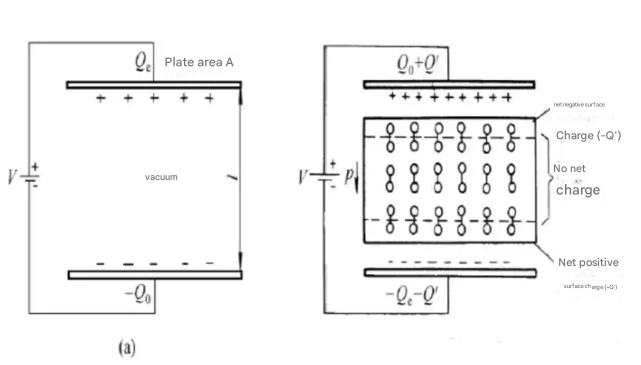
Under the action of an electric field, all substances that can produce polarization are also called dielectrics. Dielectrics are used in the electronics industry as substrates for integrated circuits, capacitors, etc. If a piece of dielectric is placed in a parallel electric field, it can be found that a charge is induced on the surface of the dielectric, that is, the dielectric near the positive plate induces a negative charge, and the dielectric surface near the negative plate induces a positive charge. This phenomenon of induced charge in the dielectric under the action of an electric field is called dielectric polarization. The reason for the generation of induced charge is that the center of gravity of the positive and negative charges of the particles (atoms, molecules, ions) inside the medium is separated under the action of the electric field, and becomes a dipole. Different dipoles have different electric dipole moments, and the direction of the electric dipole moment is consistent with the direction of the external electric field.
2.What is the dielectric constant?
Dielectric constant: The ratio of the capacitance of a capacitor of the same size made of an insulating material as a medium to that of a capacitor of the same size made of a vacuum as a medium.
It indicates the amount of electrostatic energy accumulated per unit volume in a unit electric field. It is a macroscopic physical quantity that characterizes the ability of a dielectric to polarize and store charge.
Dielectric loss The energy loss of a medium placed in an AC electric field in the form of internal heating (temperature increase).
It is usually represented by the Greek letter ε, and is a physical quantity that describes the response of a medium in an electric field. It is the ratio of the ability to store electric field energy in a medium to the storage capacity in a vacuum. The dielectric constant reflects the dielectric constant relative to the vacuum.
Specifically, the dielectric constant describes the ability of a medium to respond to an electric field. When a medium is placed in an external electric field, the larger the dielectric constant, the higher the polarization degree of the medium molecules or atoms under the electric field force, thereby storing more electrical energy in the medium. The dielectric constant is usually positive, indicating that the polarization effect of the medium will increase the effect of the electric field; but there are also negative values. For example, in metals, its dielectric constant changes from positive to negative as the frequency increases. This is called the surface plasmon resonance phenomenon of metals. The dielectric constant can also be expressed in the form of a relative dielectric constant, that is, the ratio of the dielectric constant to vacuum:
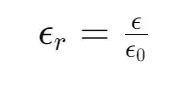
Where εr is the relative dielectric constant and ε0 is the dielectric constant of vacuum, which is about 8.854×10⁻¹²F/m. The dielectric constant of PCB (Printed Circuit Board) depends on the substrate material used. The substrate material of PCB is usually an insulating material with a high dielectric constant. Common materials include:
FR-4: This is one of the most common PCB substrate materials. It is a glass fiber reinforced epoxy resin composite material with a dielectric constant of approximately 4.0 to 4.5.
FR-1, FR-2, FR-3: These are also commonly used PCB substrate materials, and the dielectric constant is usually slightly higher than FR-4, about 4.0 to 5.0.
PTFE (polytetrafluoroethylene): PTFE is a low dielectric constant material, usually used in high-frequency applications, with a dielectric constant of about 2.1 to 2.3.
RO4000 series: This is a series of PCB substrate materials designed specifically for high-frequency applications, with a dielectric constant usually between 3.38 and 3.66.
These dielectric constants are measured at specific frequencies and may vary depending on factors such as material manufacturers, board thickness, and board layer stacking methods. Choosing the appropriate PCB substrate material depends on the requirements of the specific application, including considerations such as operating frequency, signal speed, and signal integrity.
3.What is dielectric loss?
Dielectric loss: The energy loss caused by the insulating material under the action of an electric field due to the hysteresis effect of dielectric conductivity and dielectric polarization. It is also called dielectric loss, or dielectric loss for short.
When a dielectric is exposed to an external electric field, it will generate heat inside, which means that part of the electrical energy has been converted into heat energy and dissipated. The energy consumed by the dielectric due to heat generation per unit time under the action of the electric field is called the dielectric loss power, or dielectric loss for short. Dielectric loss is one of the important quality indicators of dielectrics used in AC electric fields. Dielectric loss not only consumes electrical energy, but also causes the components to heat up and affect their normal operation. If the dielectric loss is large, it may even cause overheating of the dielectric and insulation damage, so in this sense, the smaller the dielectric loss, the better.
4.How is dielectric loss generated
Dielectric loss is a phenomenon of energy loss caused by insulating materials under the action of an electric field. It is mainly caused by the conductivity and polarization hysteresis effect of the dielectric. When an insulating material is placed in an electric field, the electric field causes the charge distribution inside the material to rearrange and form polarization. However, this polarization is not immediate, but has a certain lag time. When the electric field changes, the polarization of the dielectric will also have a lag response, resulting in energy loss generated inside the dielectric.
The main mechanisms of dielectric loss are conductivity loss and polarization loss.
Conductivity loss: The free charges in the medium will move under the action of the electric field, generating current, thus causing energy loss.
Polarization loss: The polarization in the medium will be affected by the electric field, but the polarization will not immediately follow the change of the electric field, resulting in energy loss inside the medium.
Various forms of loss work in combination. Since the causes of dielectric loss are multifaceted, the forms of dielectric loss are also diverse. In addition to the two main causes of conductivity loss and polarization loss, there are other reasons for dielectric loss.
1) Leakage loss
Leakage loss is also called conductivity loss. The insulating materials used in practice are not perfect ideal dielectrics. Under the action of an external electric field, there are always some charged particles that will move and cause a weak current. This tiny current is called leakage current. When the leakage current flows through the medium, the medium heats up and loses electric energy. This dielectric loss caused by conductivity is called “leakage loss”. Since there are always some defects in actual dielectrics, there are more or less charged particles or vacancies, so the medium will suffer leakage loss regardless of whether it is under the action of a DC electric field or an AC electric field.