
PCB Sourcing for European Market: CE, RoHS, and REACH Compliance
Over 60% of electronics shipments inspected at EU borders in 2025 showed compliance failures, resulting in costly delays and rejected shipments. For electronics manufacturers sourcing PCBs from China to the European market, understanding CE marking, RoHS substance restrictions, and REACH SVHC compliance isn’t optional—it’s the difference between smooth customs clearance and expensive product recalls.
This guide covers the practical compliance requirements you need to navigate when sourcing PCBs for the European market, including updated 2026 regulations, testing documentation, and logistics considerations from China to EU.
What CE Marking Means for PCB Products
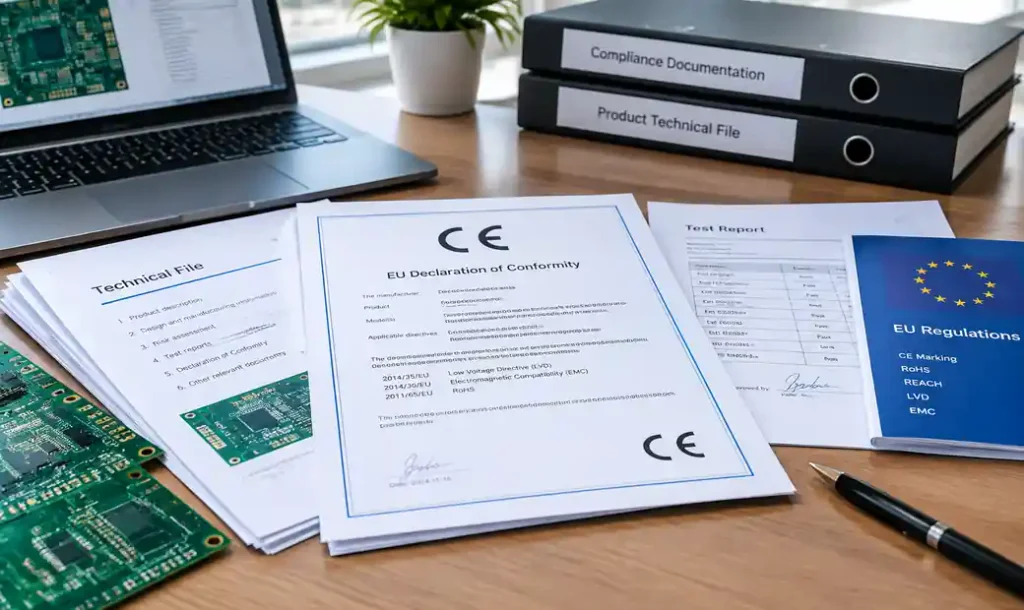
CE marking (Conformité Européenne) indicates your PCB product meets EU safety, health, and environmental requirements. For PCB products, CE marking typically involves the Low Voltage Directive (LVD) 2014/35/EU for products operating between 50-1000V AC or 75-1500V DC, and the EMC Directive 2014/30/EU for electromagnetic compatibility.
The manufacturer or authorized EU representative must affix the CE mark and prepare a Declaration of Conformity (DoC) documenting which directives apply and which standards were used for testing.
RoHS Compliance: 10 Restricted Substances You Must Control
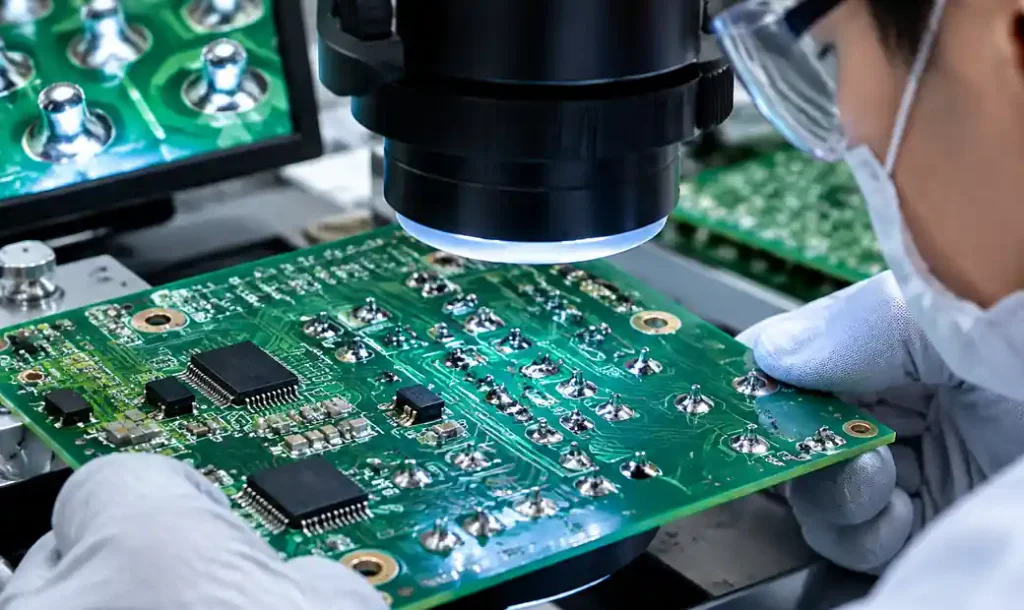
RoHS Directive 2011/65/EU restricts 10 hazardous substances in electrical and electronic equipment sold in the EU. Lead-free assembly has been the industry standard since the original 2006 RoHS directive, but you must verify compliance across your entire PCB assembly supply chain.
The 10 Restricted Substances and Thresholds
| Substance | Maximum Concentration | Common PCB Sources |
|---|---|---|
| Lead (Pb) | 0.1% (1000 ppm) | Solder, component leads, surface finishes |
| Mercury (Hg) | 0.1% (1000 ppm) | Switches, sensors, backlighting |
| Cadmium (Cd) | 0.01% (100 ppm) | Pigments, stabilizers, batteries |
| Hexavalent chromium (Cr6+) | 0.1% (1000 ppm) | Coatings, passivation layers |
| PBB (Polybrominated biphenyls) | 0.1% (1000 ppm) | Flame retardants |
| PBDE (Polybrominated diphenyl ethers) | 0.1% (1000 ppm) | Flame retardants |
| DEHP, BBP, DBP, DIBP (Phthalates) | 0.1% each (1000 ppm) | Cable insulation, plastics |
These limits apply to homogeneous materials—meaning each individual material layer in your PCB must comply separately. You cannot average the concentration across the entire board assembly.
Critical 2026 RoHS Updates
On July 21, 2026, three RoHS exemptions expired affecting PCB manufacturing. However, the exemption for copper alloys containing up to 4% lead by weight extends until June 30, 2027. The EU Commission opened infringement proceedings against seven member states in July 2026, signaling stricter enforcement. Verify your PCB manufacturer uses SAC305 (96.5% tin, 3.0% silver, 0.5% copper) lead-free solder alloys.
REACH SVHC Compliance: Managing 253 Substances of Very High Concern
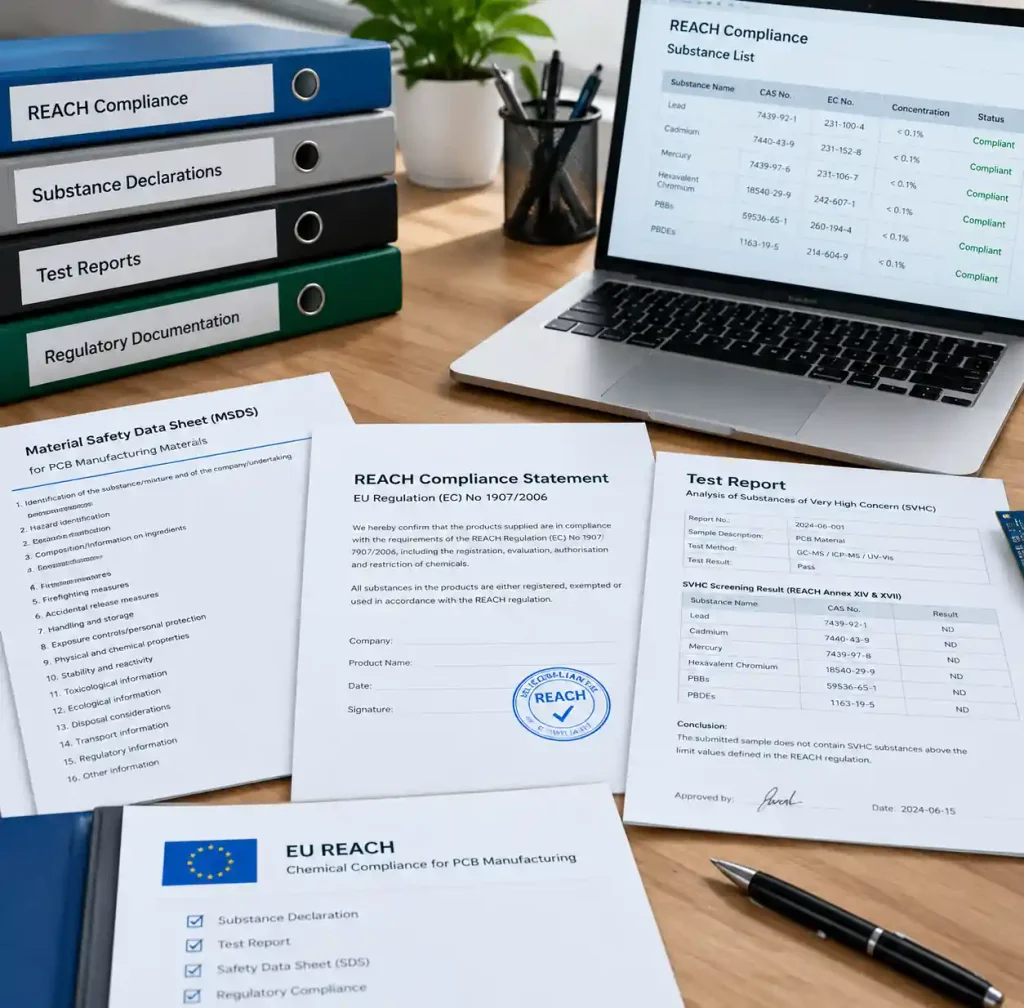
REACH Regulation (EC) 1907/2006 requires identifying and communicating Substances of Very High Concern (SVHC) in your products. As of February 2026, the Candidate List contains 253 SVHCs.
If any SVHC exceeds 0.1% weight by weight in any component, you must provide safe-use information to customers, notify ECHA through SCIP if SVHC content exceeds 1 tonne per year, and provide SVHC information within 45 days upon request.
The 0.1% threshold applies to each component separately. Common SVHCs in PCB manufacturing include certain phthalates, lead compounds in brass, flame retardants in laminates, and cobalt compounds in surface finishes.
Documentation Requirements for EU Customs Clearance
Proper documentation prevents customs delays. When importing PCBs from China to the EU, you need comprehensive technical documentation proving compliance.
Essential Compliance Documents
| Document Type | Purpose | Issuer |
|---|---|---|
| Declaration of Conformity (DoC) | Declares CE compliance with applicable directives | Manufacturer or EU rep |
| RoHS Test Reports | Proves substance compliance via XRF or ICP testing | Third-party test lab (ISO 17025) |
| REACH SVHC Declaration | Lists SVHCs >0.1% and confirms compliance | PCB manufacturer |
| Technical File | Contains design specs, risk assessments, test data | Manufacturer |
| Bill of Materials (BoM) | Lists all components and materials | Manufacturer |
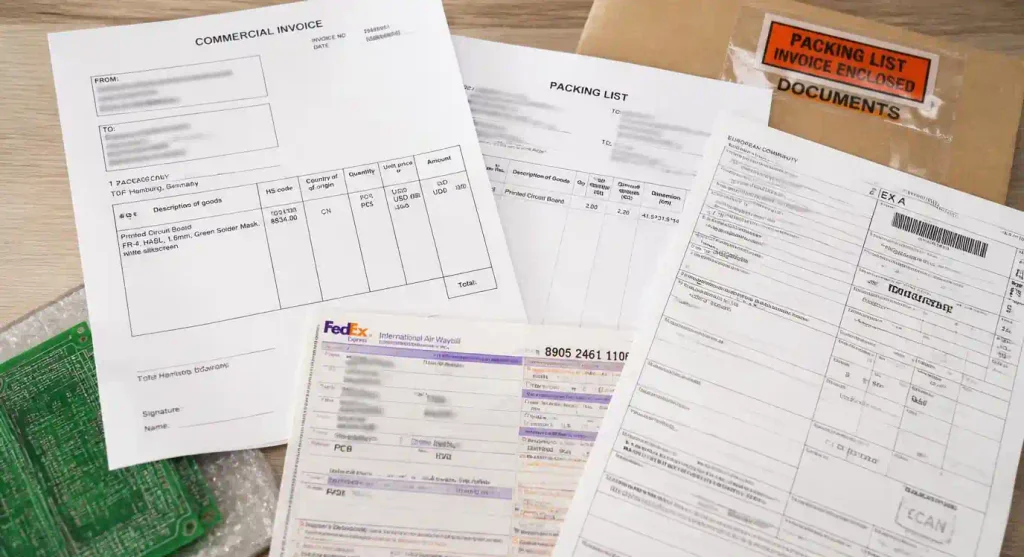
| Commercial Invoice | Declares value, HS code, origin | Exporter |
Your technical file must include PCB specifications, component datasheets with compliance certificates, test reports for EMC and safety testing, risk assessment documentation, and assembly process documentation.
PCBs typically fall under HS code 8534.00 for printed circuits. Incorrect HS codes cause customs delays and fines.
Testing and Certification: What You Actually Need
CE marking is typically self-certified for most PCB products through internal testing and documentation, though accredited test labs add credibility.
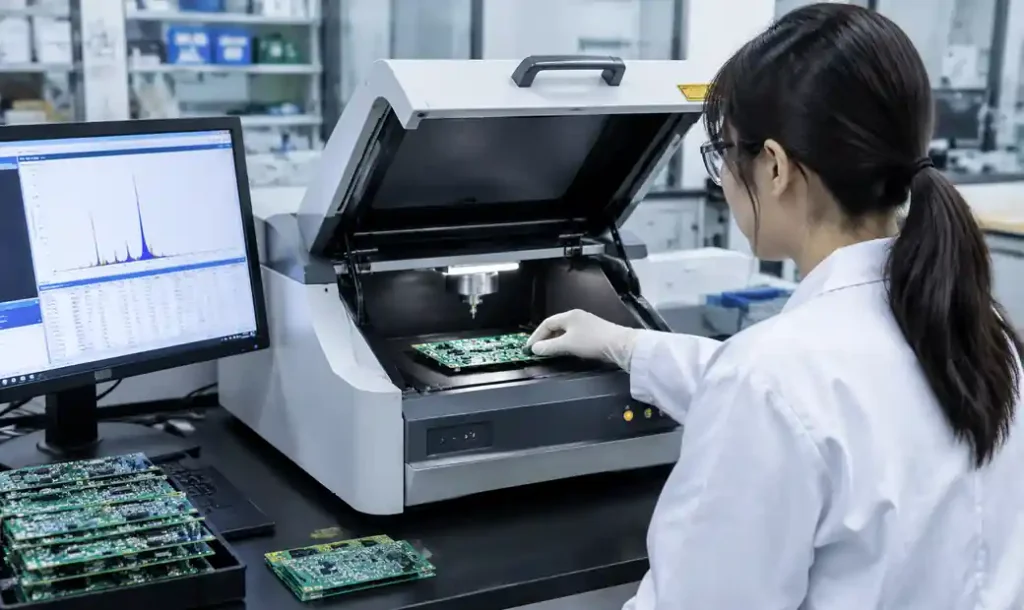
For RoHS compliance, use XRF testing for initial screening, followed by ICP-OES or ICP-MS for definitive analysis. XRF provides results within minutes, while ICP testing requires sample destruction but gives precise ppm-level measurement.
Test each homogeneous material separately—solder joints, copper traces, PCB substrate, solder mask, and each component type. Random sampling follows IPC standards, typically testing 13 samples per lot.
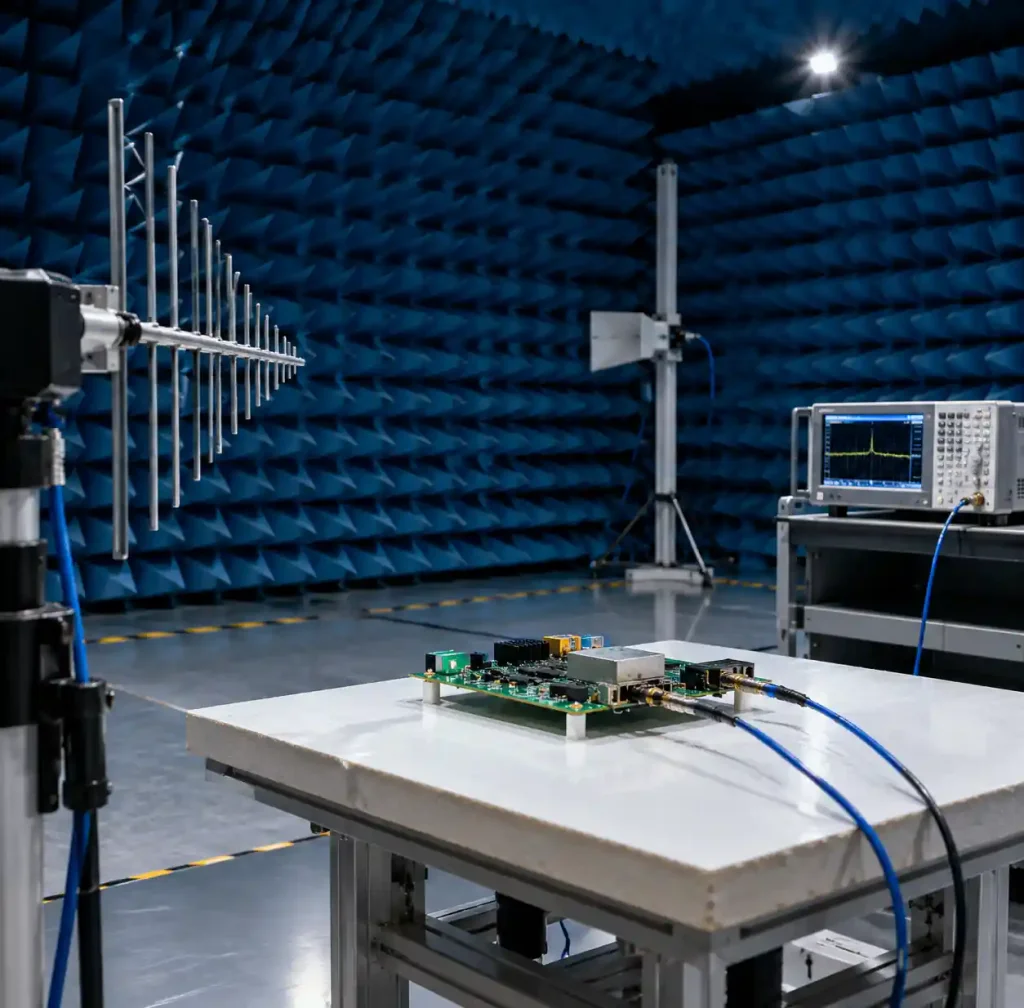
EMC testing per EN 55032 and EN 55035 applies if your PCB is a complete product. Bare boards don’t require EMC testing, but populated PCBA typically does. Testing costs range from €2,000-€8,000 depending on complexity.
Logistics and Lead Time: China to EU
Air freight takes 5-8 days door-to-door including customs clearance, while sea freight requires 30-45 days but costs 70-85% less for shipments above 100kg.
Choosing the Right Shipping Method
| Shipping Method | Transit Time | Cost Range | Best For |
|---|---|---|---|
| Express Air (DHL, FedEx, UPS) | 3-5 days | High (€8-15/kg) | Prototypes, urgent orders <25kg |
| Standard Air Freight | 7-10 days | Medium (€4-7/kg) | Production orders 25-300kg |
| Sea Freight LCL | 35-45 days | Low (€1-2/kg) | Volume >300kg, planned inventory |
| Sea Freight FCL | 30-40 days | Lowest (€500-800/m³) | Container loads, bulk orders |
Express couriers handle customs clearance, making them ideal for prototypes under 25kg despite premium cost. Standard air freight through freight forwarders costs less for 25-300kg shipments.
Sea freight becomes cost-effective above 300kg. LCL (Less than Container Load) consolidates your shipment, while FCL (Full Container Load) provides exclusive container space. Factor an additional 3-5 days for customs clearance at EU ports.
The July 1, 2026 EU customs reform eliminated the €150 low-value exemption and introduced stricter pre-clearance requirements, extending customs processing by 1-3 days. Work with freight forwarders experienced in EU electronics imports.

Working with PCB Manufacturers: Compliance Verification
Not all Chinese PCB manufacturers maintain EU-required documentation standards. Verify your manufacturer’s compliance capabilities before ordering.
Request current RoHS and REACH certificates for all PCB materials—FR-4 substrate, copper foil, solder mask, silkscreen, surface finishes, and solder paste. Certificates should show test dates within 12 months.
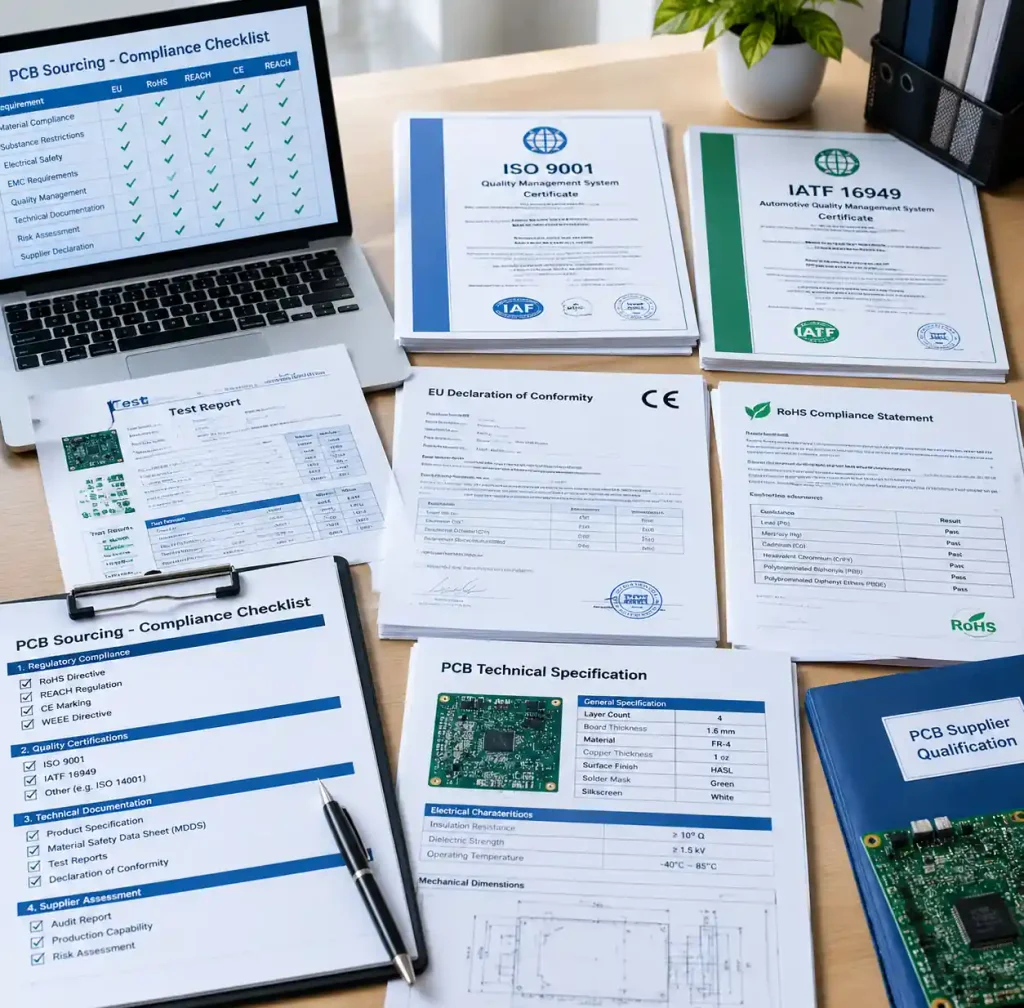
Ask for sample technical files or DoC documents from previous EU customers. Experienced manufacturers maintain template documentation. Verify ISO 9001, IATF 16949, and UL certifications.
Andwin Circuits maintains comprehensive compliance documentation for all materials and provides complete technical files. Our facility is certified to ISO 9001, IATF 16949, and UL standards, with capabilities up to 50 layers and 7-day fast delivery.

Practical Compliance Checklist for EU PCB Sourcing
Use this checklist to verify compliance before shipping PCBs to the European market:
Pre-Order Verification:
- Confirm manufacturer maintains current RoHS/REACH certificates
- Request sample DoC and technical file documentation
- Verify SAC305 lead-free solder process
- Confirm component traceability documentation
Documentation Package:
- Declaration of Conformity listing EU directives
- RoHS test reports from ISO 17025 lab (within 12 months)
- REACH SVHC declaration (253-substance list)
- Bill of Materials with component certificates
- Technical file with PCB specs and assembly documentation
Customs and Logistics:
- Verify HS code classification (8534.00 for PCB)
- Prepare commercial invoice with value and origin
- Use EU electronics import experienced forwarder
- Allow 5-8 days air or 35-45 days sea freight
Ongoing Compliance:
- Monitor ECHA for new SVHCs (twice yearly)
- Review RoHS exemptions annually
- Maintain documentation for 10 years
- Update files when changing specifications
Frequently Asked Questions
Do I need CE marking on bare PCB boards?
Bare boards without components don’t require CE marking. However, RoHS substance restrictions apply to PCB materials.
What happens if customs finds non-compliant products?
Products are detained and you receive a formal notice. You can provide additional documentation, modify products, or re-export at your expense. Failures can result in destruction, fines up to €100,000, and import bans.
How often should I update RoHS test reports?
Update reports when changing materials, processes, or suppliers. Annual testing is recommended. Many EU customers require reports dated within 12 months.
Can my Chinese manufacturer act as the CE marking manufacturer?
Yes, but they must appoint an EU authorized representative to interface with authorities and maintain documentation. Most importers choose this route to keep liability with the original manufacturer.
Conclusion
Sourcing PCBs for the European market requires systematic compliance verification across CE marking, RoHS restrictions, and REACH SVHC disclosure. The July 2026 exemption changes and stricter customs enforcement make proactive documentation critical.
Work with manufacturers who maintain current compliance certificates, understand EU requirements, and provide complete technical files. Proper documentation prevents customs delays and ensures EU market access.
Andwin Circuits provides comprehensive CE, RoHS, and REACH support with manufacturing capabilities up to 50 layers and 7-day fast delivery. Our facility is ISO 9001, IATF 16949, and UL certified. Contact us for PCB solutions with verified compliance documentation and competitive pricing.