PCB Conformal Coating Spray: A Comprehensive Guide
Introduction
Printed Circuit Boards (PCBs) are the backbone of modern electronic devices, found in everything from consumer electronics to industrial machinery and aerospace systems. However, PCBs are vulnerable to environmental factors such as moisture, dust, chemicals, and temperature fluctuations, which can lead to corrosion, short circuits, and eventual failure. To protect PCBs from these hazards, conformal coating is applied as a thin protective layer. Among the various application methods, conformal coating spray is one of the most efficient and widely used techniques.
This article explores PCB conformal coating spray, discussing its benefits, types of coatings, application methods, best practices, and common challenges.
What is Conformal Coating Spray?
Conformal coating spray is a method of applying a thin, protective polymeric film over a PCB to shield it from environmental damage. The coating “conforms” to the board’s contours, covering components, solder joints, and traces without interfering with electrical functionality. Spray application is preferred for its speed, uniformity, and ability to coat complex geometries.
Key Benefits of Conformal Coating Spray
- Environmental Protection – Shields against moisture, dust, chemicals, and salt spray.
- Electrical Insulation – Prevents short circuits and leakage currents.
- Mechanical Stability – Reduces stress from vibration and thermal cycling.
- Extended Lifespan – Enhances PCB durability in harsh conditions.
- Cost-Effective Application – Faster than manual brushing or dipping, reducing labor costs.
Types of Conformal Coatings Used in Spray Applications
Several types of conformal coatings are available, each with unique properties suited for different environments. The most common types include:
1. Acrylic (AR)
- Pros: Easy to apply and remove, good moisture resistance, UV stability.
- Cons: Limited chemical resistance.
- Applications: Consumer electronics, automotive electronics.
2. Silicone (SR)
- Pros: Excellent flexibility, high-temperature resistance, good moisture protection.
- Cons: Difficult to remove, prone to attracting dust.
- Applications: High-temperature environments (e.g., automotive, aerospace).
3. Urethane (UR)
- Pros: Strong chemical and abrasion resistance.
- Cons: Difficult to rework, requires solvents for removal.
- Applications: Military, industrial, and marine electronics.
4. Epoxy (ER)
- Pros: Hard, durable coating with excellent moisture and chemical resistance.
- Cons: Brittle, difficult to rework.
- Applications: Harsh industrial environments.
5. Parylene (XY)
- Pros: Ultra-thin, pinhole-free, excellent chemical and moisture resistance.
- Cons: Requires specialized vapor deposition equipment (not typically sprayed).
- Applications: Medical devices, aerospace.
For spray applications, acrylic, silicone, and urethane are the most commonly used due to their ease of application and curing properties.
Methods of Spray Application
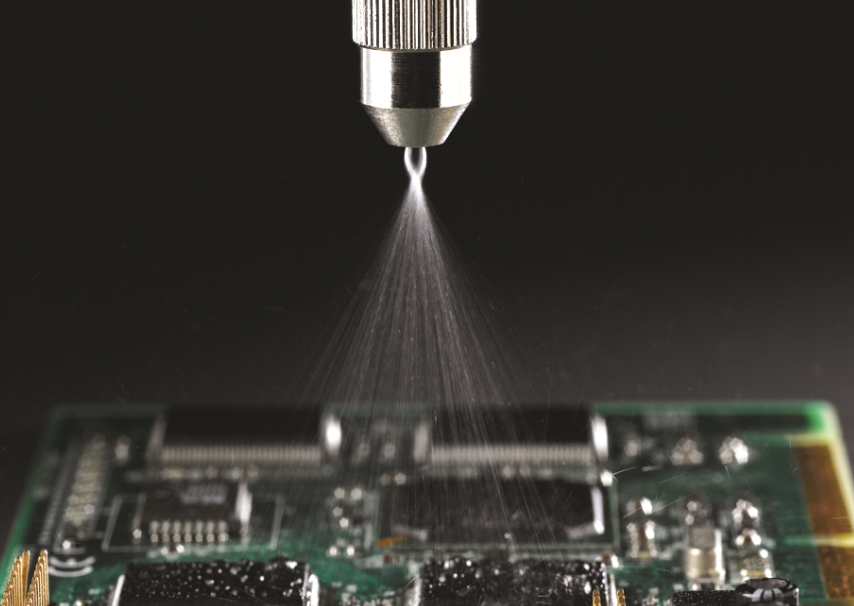
Spray coating can be applied manually or using automated systems, depending on production volume and precision requirements.
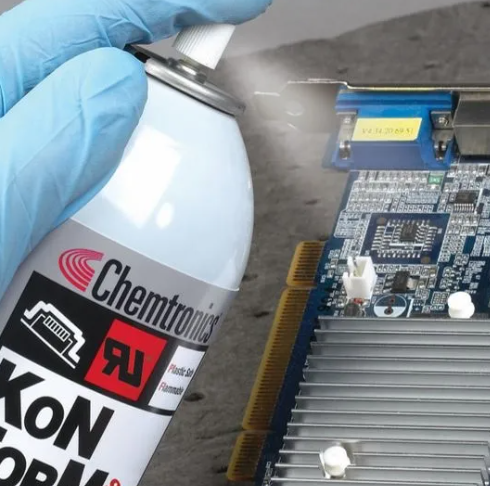
1. Aerosol Spray (Manual)
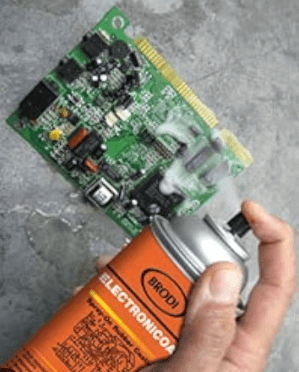
- Process: The coating is packaged in a pressurized can with a nozzle for manual spraying.
- Advantages: Low cost, portable, suitable for small batches.
- Disadvantages: Inconsistent thickness, overspray, operator-dependent quality.
2. Spray Gun (Manual or Semi-Automated)
- Process: Uses an airbrush or HVLP (High Volume Low Pressure) spray gun for better control.
- Advantages: More uniform coating than aerosol, adjustable spray patterns.
- Disadvantages: Requires skill, potential for overspray.
3. Automated Spray Systems
- Process: Robotic spray systems with programmable paths for high-volume production.
- Advantages: High precision, repeatability, minimal waste.
- Disadvantages: Higher initial cost, requires setup and maintenance.
4. Selective Coating Machines
- Process: Uses robotic nozzles to apply coating only to specific areas, masking unnecessary parts.
- Advantages: No masking required, high efficiency.
- Disadvantages: Expensive, best for high-volume production.
Best Practices for PCB Conformal Coating Spray
To ensure optimal protection and performance, follow these best practices:
1. Surface Preparation
- Clean the PCB thoroughly to remove flux residues, dust, and oils.
- Use isopropyl alcohol or specialized cleaners.
- Ensure the board is completely dry before coating.
2. Masking Critical Areas
- Cover connectors, switches, and test points with masking tape or liquid mask.
- Use selective spraying if automation is available.
3. Optimal Spray Technique
- Maintain a consistent distance (6-12 inches) from the PCB.
- Apply multiple thin coats instead of one thick layer to avoid drips.
- Use even, sweeping motions for uniform coverage.
4. Curing Process
- Allow proper curing time based on the coating type (air dry, heat cure, or UV cure).
- Ensure adequate ventilation to avoid solvent buildup.
5. Inspection & Quality Control
- Check for uniform coverage using UV light (for UV tracer coatings).
- Look for bubbles, pinholes, or uncoated areas.
- Perform electrical testing to ensure no insulation issues.
Common Challenges & Solution
1. Inconsistent Coating Thickness
- Cause: Uneven spraying, incorrect viscosity.
- Solution: Adjust spray distance, use thinner if needed, or switch to automated systems.
2. Overspray & Contamination
- Cause: Spray drifting onto unintended areas.
- Solution: Use masking, improve spray control, or use selective coating.
3. Bubbles & Pinholes
- Cause: Trapped air or moisture.
- Solution: Ensure proper drying, degas the coating material, and apply thinner layers.
4. Poor Adhesion
- Cause: Contaminated or improperly cleaned PCB.
- Solution: Improve cleaning procedures, use adhesion promoters if necessary.
5. Curing Issues
- Cause: Humidity, temperature fluctuations.
- Solution: Control the curing environment, follow manufacturer guidelines.
Conclusion
PCB conformal coating spray is a highly effective method for protecting electronic assemblies from environmental and mechanical stresses. By selecting the right coating material, application technique, and adhering to best practices, manufacturers can significantly enhance PCB reliability and longevity.
While manual spraying is suitable for prototyping and low-volume production, automated and selective spray systems offer superior precision for high-volume manufacturing. As electronic devices continue to evolve, advancements in conformal coating sprays—such as UV-curable and environmentally friendly formulations—will further improve performance and sustainability.
For engineers and manufacturers, understanding the nuances of conformal coating spray ensures optimal protection, reduced failure rates, and extended product life in even the harshest conditions.