Selection of magnetic beads in PCB circuit design
Reasons for using chip magnetic beads and chip inductors: Whether to use chip magnetic beads or chip inductors mainly depends on the application. Chip inductors are needed in resonant circuits. When it is necessary to eliminate unwanted EMI noise, using chip magnetic beads is the best choice.
1.The unit of magnetic beads is ohm, not hunter, which should be paid special attention to.
Because the unit of magnetic beads is nominal according to the impedance it produces at a certain frequency, the unit of impedance is also ohm. The DATASHEET of magnetic beads generally provides a characteristic curve of frequency and impedance, generally based on 100MHz, such as 1000R 100MHz, which means that at a frequency of 100MHz, the impedance of the magnetic beads is equivalent to 600 ohms.
2.Ordinary filters are composed of lossless reactive elements.
Its function in the line is to reflect the stopband frequency back to the signal source, so this type of filter is also called a reflection filter. When the reflection filter does not match the signal source impedance, part of the energy will be reflected back to the signal source, causing the interference level to increase. To solve this problem, ferrite magnetic rings or magnetic beads can be used on the incoming line of the filter, and the eddy current loss of the high-frequency signal by the ferrite rings or magnetic beads can be used to convert the high-frequency component into heat loss. Therefore, the magnetic rings and magnetic beads actually absorb the high-frequency components, so they are sometimes called absorption filters.
Different ferrite suppression elements have different optimal suppression frequency ranges.
Generally, the higher the magnetic permeability, the lower the suppression frequency. In addition, the larger the volume of the ferrite, the better the suppression effect. Some experts on the I Love Solutions website have found that when the volume is constant, the long and thin shape has a better suppression effect than the short and thick one, and the smaller the inner diameter, the better the suppression effect.
However, in the case of DC or AC bias current, there is still the problem of ferrite saturation.
The larger the cross-section of the suppression element, the less likely it is to saturate, and the larger the bias current it can withstand. When the EMI absorption magnetic ring/magnetic bead suppresses differential mode interference, the current value passing through it is proportional to its volume. The imbalance between the two causes saturation, which reduces the performance of the component. When suppressing common mode interference, the two wires (positive and negative) of the power supply pass through a magnetic ring at the same time.
The effective signal is a differential mode signal, and the EMI absorption magnetic ring/magnetic bead has no effect on it, but it will show a large inductance for the common mode signal. Another good way to use the magnetic ring is to let the wire passing through the magnetic ring be repeatedly wound several times to increase the inductance. According to its suppression principle for electromagnetic interference, its suppression effect can be used reasonably.
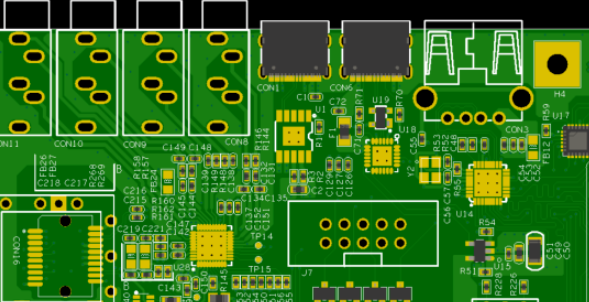
Ferrite suppression components should be installed close to the interference source.
For input/output circuits, they should be as close as possible to the entrance and exit of the shielding shell. For the absorption filter composed of ferrite magnetic rings and magnetic beads, in addition to selecting lossy materials with high magnetic permeability, it is also necessary to pay attention to its application occasions. The resistance they present to high-frequency components in the circuit is about ten to several hundred Ω, so it is not obvious in high-impedance circuits. On the contrary, it will be very effective in low-impedance circuits (such as power distribution, power supply or radio frequency circuits).
Since ferrite can attenuate higher frequencies while allowing lower frequencies to pass almost unimpeded, it has been widely used in EMI control.
Magnetic rings/magnetic beads used for EMI absorption can be made into various shapes and are widely used in various occasions. For example, on PCB boards, they can be added to DC/DC modules, data lines, power lines, etc. It absorbs high-frequency interference signals on the line, but will not generate new zeros and poles in the system, and will not destroy the stability of the system. It is used in conjunction with power supply filters to well supplement the shortcomings of the high-frequency end performance of the filter and improve the filtering characteristics of the system.
Magnetic beads are specially used to suppress high-frequency noise and spike interference on signal lines and power lines, and also have the ability to absorb electrostatic pulses.
Magnetic beads are used to absorb ultra-high frequency signals. Some RF circuits, PLL, oscillation circuits, and ultra-high frequency memory circuits (DDR SDRAM, RAMBUS, etc.) all require magnetic beads to be added to the power input part. Inductors are energy storage components used in LC oscillation circuits, medium and low frequency filter circuits, etc., and their application frequency range rarely exceeds 50MHZ.
The function of magnetic beads is mainly to eliminate RF noise existing in the transmission line structure (circuit).
RF energy is an AC sine wave component superimposed on the DC transmission level. The DC component is the required useful signal, while the RF energy is useless electromagnetic interference transmitted and radiated along the line (EMI). To eliminate these unwanted signal energies, chip magnetic beads are used to play the role of high-frequency resistors (attenuators). The device allows DC signals to pass through and filters out AC signals. Usually the high-frequency signal is above 30MHz, however, low-frequency signals will also be affected by chip magnetic beads.
Chip magnetic beads are composed of soft magnetic ferrite materials, forming a monolithic structure with high volume resistivity.
Eddy current loss is inversely proportional to the resistivity of ferrite materials. Eddy current loss is proportional to the square of the signal frequency. Advantages of using chip beads: Miniaturization and lightweight High impedance in the RF noise frequency range, eliminating electromagnetic interference in the transmission line. Closed magnetic circuit structure, better eliminate signal crosstalk. Excellent magnetic shielding structure. Reduce DC resistance to avoid excessive attenuation of useful signals. Significant high-frequency characteristics and impedance characteristics (better elimination of RF energy). Eliminate parasitic oscillations in high-frequency amplifier circuits. Effectively work in the frequency range of several MHz to hundreds of MHz.
To correctly choose magnetic beads, the Electronic Components Technology Network gives some core suggestions:
- What is the frequency range of the unwanted signal;
- Who is the noise source;
- Is there space to place magnetic beads on the PCB board;
- How much noise attenuation is required;
- What are the environmental conditions (temperature, DC voltage, structural strength);
- What is the circuit and load impedance;
The first three can be judged by observing the impedance frequency curve provided by the manufacturer.
In the impedance curve, all three curves are very important, namely resistance, inductance and total impedance. The total impedance is described by ZR22πfL()2+:=fL. Through this curve, select the bead model with the maximum impedance in the frequency range where the noise is expected to be attenuated and the minimum signal attenuation at low frequency and DC. The impedance characteristics of chip beads will be affected under excessive DC voltage. In addition, if the operating temperature rise is too high or the external magnetic field is too large, the impedance of the beads will be adversely affected. You can also go to the Shenzhen Electronics Exhibition to choose. The reason for using chip beads and chip inductors: whether to use chip beads or chip inductors mainly depends on the application. Chip inductors are required in resonant circuits. When it is necessary to eliminate unwanted EMI noise, using chip beads is the best choice.
Applications of chip beads and chip inductors:
Chip inductors: radio frequency (RF) and wireless communications, information technology equipment, radar detectors, automobiles, cellular phones, pagers, audio equipment, PDAs (personal digital assistants), wireless remote control systems, and low-voltage power supply modules, etc.
Chip beads: clock generation circuits, filtering between analog circuits and digital circuits, I/O input/output internal connectors (such as serial ports, parallel ports, keyboards, mice, long-distance telecommunications, local area networks), between radio frequency (RF) circuits and susceptible logic devices, filtering out high-frequency conducted interference in power supply circuits, EMI noise suppression in computers, video recorders (VCRS), TV systems and mobile phones.