
Switched Power Supply Circuit: Design, Operation, and Applications
Introduction
Switched-mode power supplies (SMPS) have revolutionized power conversion technology, offering significant advantages over traditional linear power supplies in terms of efficiency, size, and weight. These electronic power supplies incorporate a switching regulator to convert electrical power efficiently from one form to another with desired characteristics. This article explores the fundamental principles, circuit topologies, design considerations, and applications of switched power supply circuits.
Basic Principles of Switched Power Supplies
Comparison with Linear Regulators
Unlike linear regulators that dissipate excess power as heat to maintain output voltage, switched power supplies rapidly switch the input voltage on and off, adjusting the duty cycle to control the average output voltage. This fundamental difference leads to several advantages:
- Higher efficiency (typically 70-95% compared to 30-60% for linear regulators)
- Reduced heat generation
- Smaller size and weight due to higher frequency operation
- Ability to step-up, step-down, or invert input voltage
Key Operating Principles
Switched power supplies operate on the principle of pulse-width modulation (PWM), where the input DC voltage is chopped at high frequency (typically 20kHz to several MHz) by power semiconductor switches. The resulting pulsed waveform is then filtered to produce a smooth DC output.
The output voltage regulation is achieved by controlling the duty cycle (the ratio of on-time to switching period) of the switching waveform. Feedback mechanisms continuously monitor the output voltage and adjust the duty cycle to maintain stable output despite variations in input voltage or load current.
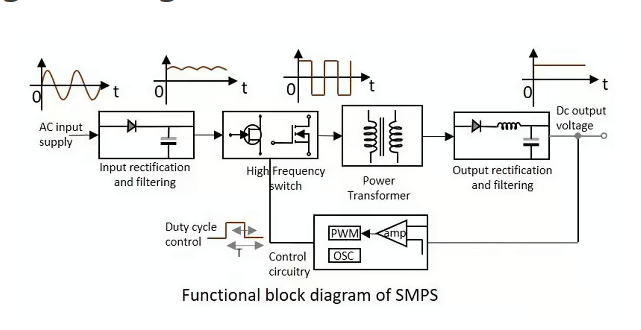
Major Components of SMPS Circuits
1. Input Rectifier and Filter
The input stage typically consists of:
- Rectifier (for AC inputs) to convert AC to DC
- Input filter capacitor to reduce ripple
- Inrush current limiting circuit
2. Switching Element
Modern SMPS designs use various semiconductor devices as switches:
- Power MOSFETs (most common for lower voltage applications)
- IGBTs (for higher power applications)
- GaN and SiC transistors (for high-frequency, high-efficiency designs)
3. Energy Storage Elements
- Inductors: Store energy in their magnetic field when current flows
- Transformers: Provide isolation and voltage scaling
- Capacitors: Filter and smooth the output voltage
4. Control Circuit
The heart of regulation includes:
- PWM controller IC
- Feedback network (voltage divider, error amplifier)
- Protection circuits (overvoltage, overcurrent, thermal)
5. Output Rectifier
For isolated topologies:
- Schottky diodes (for lower voltage drops)
- Synchronous rectifiers (MOSFETs) for highest efficiency
Common SMPS Topologies
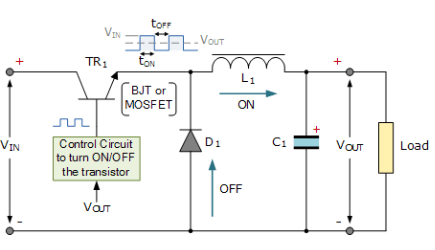
1. Buck Converter (Step-down)
The buck converter produces an output voltage lower than its input voltage. Key characteristics:
- Simple design with single switch
- High efficiency (can exceed 95%)
- Continuous or discontinuous conduction modes
Applications: Voltage regulators for processors, LED drivers, battery chargers.
2. Boost Converter (Step-up)
The boost converter generates output voltage higher than input. Features include:
- Ability to boost voltage significantly
- Requires careful design to prevent output overshoot
- Used in battery-powered devices, LED drivers, power factor correction
3. Buck-Boost Converter
This versatile topology can either step-up or step-down the input voltage while inverting the polarity. It’s particularly useful in:
- Battery-operated equipment
- Automotive applications
- Systems requiring negative voltages
4. Flyback Converter
A popular isolated topology featuring:
- Transformer provides galvanic isolation
- Stores energy in transformer during switch on-time
- Delivers energy to output during off-time
- Commonly used in low-power AC/DC adapters
5. Forward Converter
Another isolated topology that:
- Transfers energy directly to output during switch on-time
- Requires reset winding or active clamp circuit
- Used in medium power applications (50-500W)
6. Push-Pull and Bridge Topologies
For higher power applications:
- Half-bridge and full-bridge converters
- Provide excellent transformer utilization
- Used in industrial power supplies, telecom equipment
Design Considerations for SMPS Circuits
1. Switching Frequency Selection
The choice of switching frequency involves trade-offs:
- Higher frequencies allow smaller passive components
- Increased switching losses at higher frequencies
- EMI considerations
- Typical range: 50kHz-1MHz for conventional designs
2. Component Selection
Critical components require careful specification:
- Switching devices: Voltage/current ratings, switching speed
- Magnetic components: Core material, saturation current
- Capacitors: ESR, ripple current rating
- Rectifiers: Forward voltage drop, reverse recovery time
3. Feedback and Control Loop Design
Proper control loop design ensures:
- Stable operation under all conditions
- Fast transient response
- Good line and load regulation
- Typically requires compensation network design
4. Thermal Management
Despite high efficiency, thermal design is crucial:
- Proper heatsinking for power devices
- Adequate ventilation
- Thermal protection circuits
5. EMI/EMC Considerations
Switching circuits generate electromagnetic interference:
- Input and output filtering
- Proper layout and grounding
- Shielding where necessary
- Compliance with regulatory standards
Advanced Techniques in SMPS Design
1. Synchronous Rectification
Replacing diode rectifiers with actively controlled MOSFETs:
- Significantly reduces conduction losses
- Particularly beneficial for low output voltage applications
- Requires careful timing control
2. Soft-Switching Techniques
Methods to reduce switching losses:
- Zero-voltage switching (ZVS)
- Zero-current switching (ZCS)
- Resonant converters
- Particularly valuable at higher frequencies
3. Digital Control
Increasing adoption of digital control offers:
- Programmability and flexibility
- Advanced control algorithms
- System monitoring and communication
- Adaptive control for changing conditions
4. Power Factor Correction (PFC)
Essential for AC-input supplies to:
- Meet regulatory requirements
- Reduce input current harmonics
- Improve overall efficiency
- Active PFC typically uses boost converter topology
Applications of Switched Power Supplies
1. Consumer Electronics
- Laptop and smartphone chargers
- LED lighting drivers
- Audio/video equipment
- Gaming consoles
2. Computer Systems
- Server power supplies
- Voltage regulator modules (VRMs) for CPUs/GPUs
- Peripheral power
3. Industrial Equipment
- Motor drives
- Process control systems
- Test and measurement equipment
4. Telecommunications
- Base station power systems
- Network equipment
- Fiber optic systems
5. Automotive Electronics
- Electric vehicle power conversion
- LED lighting
- Infotainment systems
- Advanced driver assistance systems (ADAS)
6. Renewable Energy Systems
- Solar microinverters
- Maximum power point tracking (MPPT)
- Battery charging systems
Challenges and Future Trends
Current Challenges in SMPS Design
- Managing EMI in increasingly dense electronic environments
- Improving reliability while reducing cost
- Meeting ever-more stringent efficiency standards
- Addressing thermal issues in compact designs
Emerging Trends
- Wide Bandgap Semiconductors:
- Gallium Nitride (GaN) and Silicon Carbide (SiC) devices
- Enable higher frequency, higher efficiency operation
- Reduce system size and weight
- Integrated Power Solutions:
- Monolithic power ICs combining controller and power devices
- Reduced component count
- Simplified design process
- Advanced Packaging:
- 3D packaging of power components
- Improved thermal performance
- Higher power density
- Smart Power Supplies:
- Incorporation of IoT capabilities
- Predictive maintenance features
- Adaptive performance optimization
Conclusion
Switched power supply circuits have become indispensable in modern electronics, offering unparalleled efficiency and flexibility compared to traditional linear regulators. From simple buck converters to complex multi-output isolated supplies, SMPS technology continues to evolve, driven by advances in semiconductor devices, magnetic materials, and control techniques.
As power demands grow and efficiency requirements become more stringent, the importance of well-designed switched-mode power supplies will only increase. Future developments in wide bandgap semiconductors, digital control, and integrated power solutions promise to further enhance the performance and reduce the size of these essential power conversion systems.
Understanding the fundamental principles, topologies, and design considerations of switched power supplies remains crucial for engineers developing next-generation electronic systems across all application domains.