
PCB Assembly for Small Batches: 10-100 Units Cost Breakdown
Small batch PCB assembly costs $15-$65 per board for 10-100 units, with setup fees accounting for 25-40% of total project cost. This guide breaks down pricing structure, component sourcing strategies, and cost optimization techniques helping hardware engineers reduce expenses without compromising quality.
Understanding Small Batch Assembly Economics
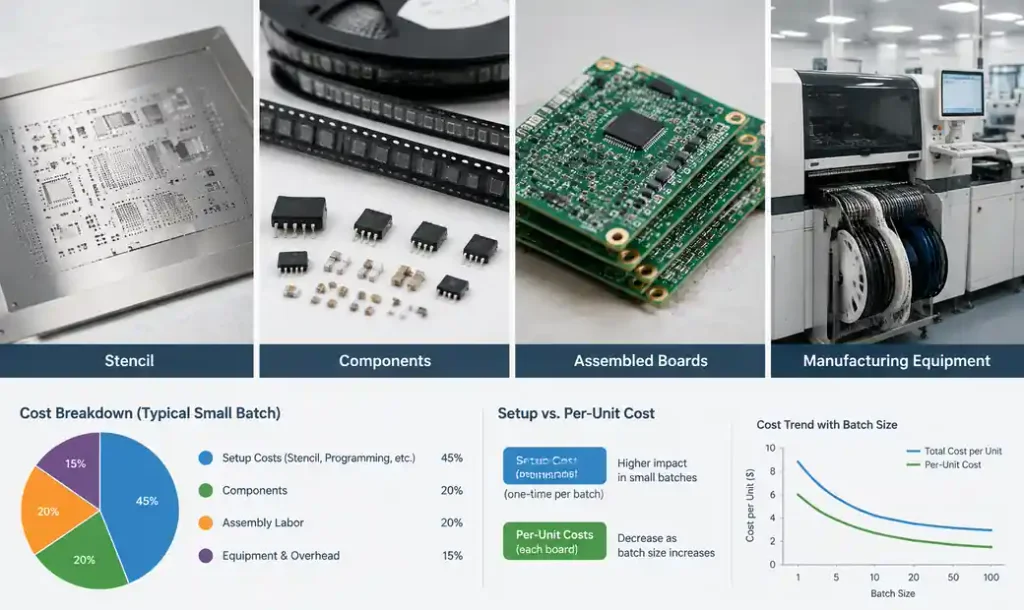
At 10-100 unit volumes, fixed setup costs dominate per-unit pricing while component procurement strategies directly impact bottom-line costs. Setup fees remain constant whether you build 10 boards or 1,000 units. A $300 stencil adds $30 per board at 10 units but only $3 at 100 units—a fundamental economic reality driving pricing decisions.
Manufacturing setup includes stencil fabrication ($50-$150), machine programming ($80-$200), first article inspection ($50-$100), and AOI calibration ($30-$80). These one-time costs total $210-$530 per design, amortizing across your unit count. You should evaluate PCB assembly services carefully when planning small batch production.
Small Batch Cost Structure Breakdown
Total cost divides into three buckets: setup/NRE fees, component costs, and assembly labor. Each category behaves differently across quantity ranges, creating nonlinear pricing curves.
| Cost Category | 10 Units | 50 Units | 100 Units | Scaling Behavior |
|---|---|---|---|---|
| Setup/NRE | $300 ($30/unit) | $300 ($6/unit) | $300 ($3/unit) | Fixed |
| Components | $180 ($18/unit) | $750 ($15/unit) | $1,200 ($12/unit) | Volume discount |
| Assembly Labor | $120 ($12/unit) | $450 ($9/unit) | $700 ($7/unit) | Efficiency gain |
| Total Cost | $600 ($60/unit) | $1,500 ($30/unit) | $2,200 ($22/unit) | Economies of scale |
This table demonstrates real-world pricing for a moderate-complexity board (60 components, mixed SMT and through-hole). Component costs drop 20-40% from 10 to 100 units due to distributor price breaks, while setup cost dilution creates the steepest curve.
NRE and Setup Fees Explained
NRE fees in HMLV assembly cover SMT stencil fabrication (laser-cut or electroformed), machine programming for pick-and-place equipment, custom test fixtures when required, and engineering review validating design for manufacturing.
Stencil costs vary by technology. Laser-cut stainless steel stencils run $50-$100 with 2-3 day lead times, suitable for 0.5mm pitch components. Electroformed nickel stencils cost $150-$250 but deliver superior paste release for fine-pitch BGAs and micro-QFNs. Programming costs scale with board complexity—simple designs with 30 components need 1-2 hours while dense layouts with 200+ parts require 4-6 hours.
Component Procurement Impact
Component sourcing drives 50-65% of small batch costs, with distributor pricing, availability, and MOQ restrictions creating procurement challenges. Authorized distributors (Digikey, Mouser, Arrow, Avnet) offer no-MOQ purchasing critical for small batches. Price breaks typically occur at 10, 25, 50, 100, and 250 units.
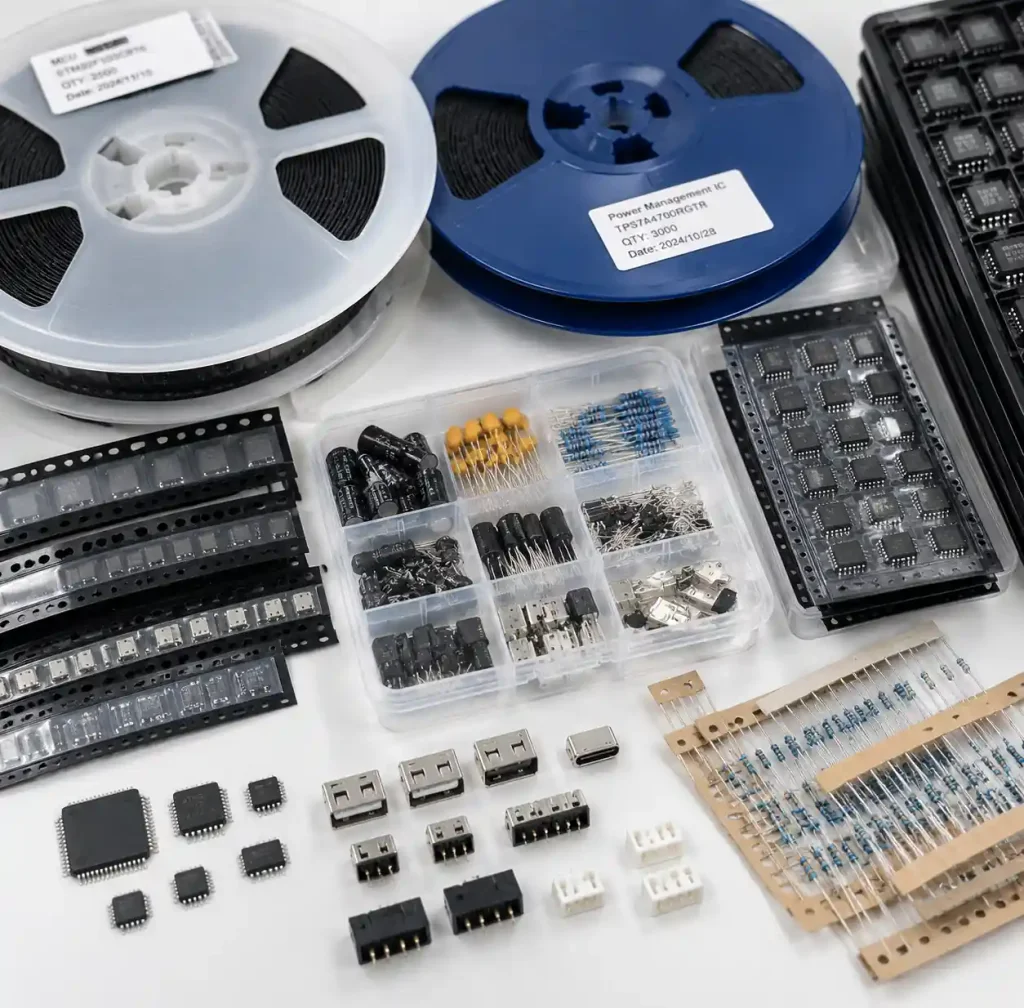
A $2.40 component at single-unit pricing drops to $1.85 at 25 units and $1.50 at 100 units—30-40% savings driving optimal order quantity decisions. Consigned assembly (you purchase components) gives procurement control but requires inventory management. Turnkey assembly (CM purchases components) simplifies logistics but adds 10-25% markup covering procurement labor.
Strategic Component Sourcing for Small Batches
Optimizing component costs requires balancing distributor pricing tiers, managing obsolescence risk, and leveraging assembly partner purchasing power.
Distributor Price Break Analysis
Component distributors publish quantity-based pricing tiers rewarding volume purchases. Calculate effective cost including storage: a $1.50 component with 100-unit price break versus $1.85 at 25 units saves $35 per build. If you need 75 units now and 50 in six months, buying 150 upfront saves money despite carrying 25 units temporarily.
Critical components warrant buffer stock. Long-lead or allocation-prone parts (microcontrollers, power management ICs, specialty connectors) should be purchased at higher quantities. A $3.20 MCU bought at 250 units ($2.45 each) saves $187.50 versus buying 100 units at $3.13 each.
Managing Component MOQs
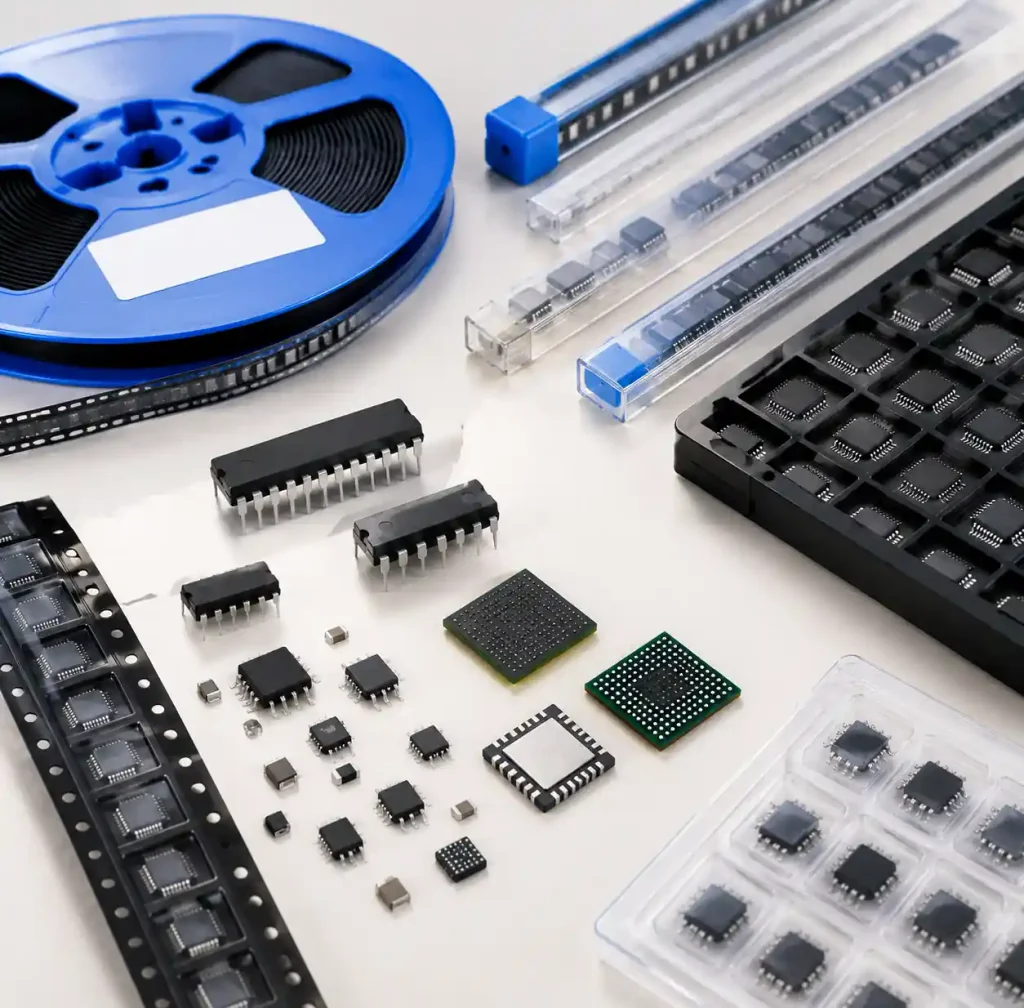
Manufacturer MOQs create procurement obstacles. Specialty components (RF modules, custom magnetics, displays) often carry 500-1,000 piece MOQs, forcing excess inventory or design changes.
| Component Type | Typical MOQ | Small-Batch Strategy | Cost Impact |
|---|---|---|---|
| Standard passives | None (distributor stock) | Order at price breaks | Minimal |
| Common ICs | None (distributor stock) | Buy full reels if using >60% | 10-20% savings |
| Specialty ICs | 250-500 units | Find alternates or negotiate | 15-35% penalty |
| Custom components | 1,000+ units | Avoid in small batches | 40-60% penalty |
Component alternates provide MOQ workarounds. Design with pin-compatible alternatives approved during BOM creation, allowing procurement flexibility.
Turnkey vs Consigned Assembly
Turnkey assembly costs 10-25% more for components but eliminates procurement labor, provides single-source accountability, and leverages CM volume purchasing. Best for teams without dedicated purchasing resources or those prioritizing speed over cost optimization.
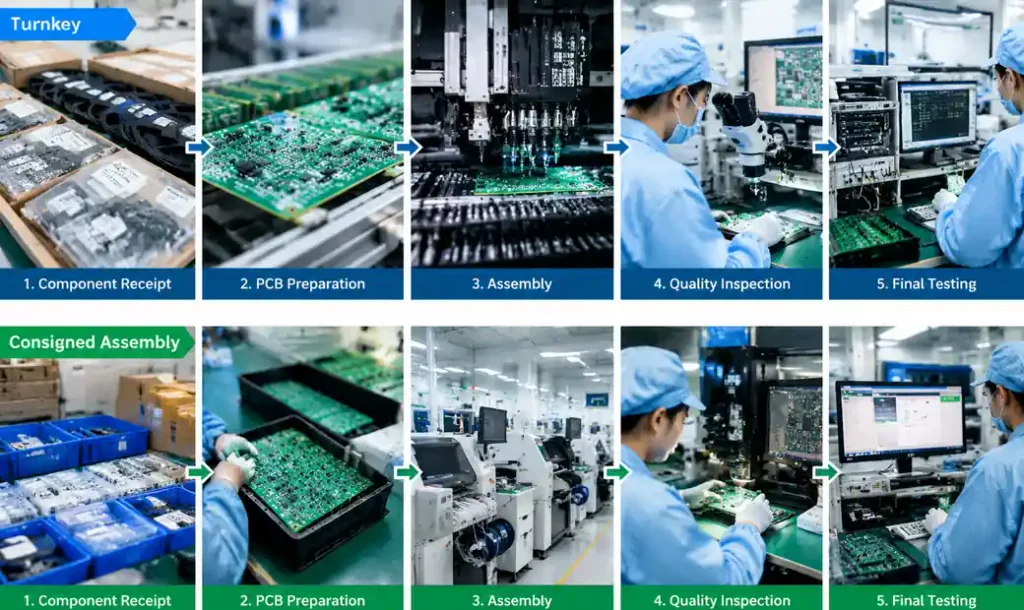
Consigned assembly gives complete component control, captures distributor loyalty rewards, and avoids CM markup. However, you absorb procurement labor (2-8 hours per BOM), manage component delivery timing, and carry inventory risk. Best for cost-sensitive projects with experienced hardware teams. Hybrid approaches optimize both models—source long-lead components yourself while having CM procure commodities.
When to Use Prototype Service vs Production Pricing
The 10-100 unit range sits between quick-turn prototype services and committed production runs. Choosing incorrectly costs 30-50% more or adds weeks to lead time.
Prototype services excel for <25 units with fast turnaround needs. Providers offer 3-5 day assembly with simplified quoting. Per-unit costs run higher ($45-$85 per board) but zero NRE fees and streamlined processes speed development cycles. Production services become cost-effective above 25-30 units despite longer lead times (7-15 days). Per-unit pricing drops to $18-$40 with full NRE cost amortization, DFM review, and better quality control. You should use quick turn PCB assembly when speed is critical for prototypes.
The crossover point depends on board complexity. Simple designs (30-50 components, single-sided SMT) favor prototype services up to 40-50 units. Complex boards (150+ components, BGAs, 0.4mm pitch) justify production pricing above 15-20 units because CM engineering adds value through DFM optimization.
Design for Manufacturing Cost Reduction
DFM optimization reduces assembly costs 20-35% without compromising functionality. Understanding PCB cost reduction strategies helps you optimize designs for manufacturability.
Panelization for Improved Utilization
Panelization combines multiple boards into single production panels, dramatically improving assembly efficiency. A 100mm × 100mm board running individually wastes 60-70% of SMT line time. Panelizing 4-6 boards together increases machine utilization to 85-90%, cutting assembly labor costs 30-40%.

Panel design requires coordination between PCB fabrication and assembly. Standard panel sizes (18″ × 24″ or 457mm × 610mm) optimize material usage. V-scoring works for rectangular boards with straight edges, while tab routing accommodates complex outlines.
Component Standardization Strategy
Reducing unique component count simplifies procurement and assembly programming. Every additional unique part number adds $8-$15 in programming time and increases component management complexity.
Standardize passive values across designs. Using E12 series resistors instead of E96 series reduces unique resistor count by 87%. Capacitor standardization on decade values (1µF, 10µF, 100µF) improves inventory turns. Choose common package sizes—0603 and 0805 imperial (1608 and 2012 metric) dominate passive inventories with best pricing. Moving from 0402 to 0603 reduces costs 10-15% while improving pick-and-place yield.
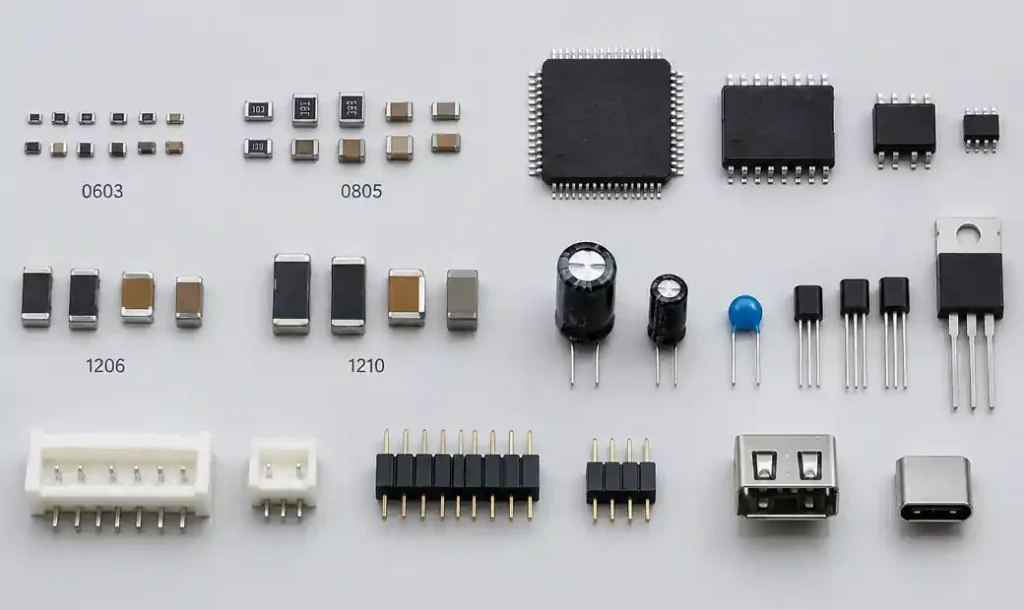
Standard component libraries maintained by your assembly partner accelerate programming. When components already exist in CM databases, programming time drops from 3-5 hours to 1-2 hours, saving $160-$240 in NRE costs.
Quality and Testing in Small Batches
Small batches require proper inspection catching issues before subsequent production runs. First article inspection (FAI) validates design intent against manufactured output—dimensional verification, component placement accuracy, solder joint quality per IPC-A-610 Class 2 standards, and electrical testing. Budget $75-$150 for comprehensive FAI.
AOI (Automated Optical Inspection) catches 85-95% of assembly defects including component placement errors, solder bridging, insufficient solder, and missing parts. Small batch runs benefit from AOI despite per-board cost impact ($1.50-$3.50 per board). X-ray inspection becomes mandatory for BGAs, QFNs, and components with hidden solder joints. Budget $2-$5 per board for X-ray on critical assemblies where field failures carry high costs.
Frequently Asked Questions
What is the typical setup fee for small batch PCB assembly?
Setup fees range from $200-$600 depending on board complexity. Simple designs (50-80 components, 0.5mm pitch) need $200-$300 setup, while complex boards (150+ components, BGAs, 0.4mm pitch) require $400-$600 covering stencil fabrication, machine programming, and first article inspection.
How do component costs change from 10 to 100 units?
Component costs typically drop 25-35% moving from 10 to 100 units due to distributor price breaks. Common ICs see 20-30% reduction, passives drop 15-25%, and specialty components (RF modules, displays) decrease 10-15%. Total BOM cost reduction averages 22-28% across this quantity range.
Should I use consigned or turnkey assembly for 50 units?
Consigned assembly saves 10-25% on component costs but requires 4-8 hours procurement labor and inventory management. Choose consigned for cost-sensitive projects with engineering bandwidth. Turnkey simplifies logistics and accelerates timeline, best for teams without purchasing resources or those prioritizing speed over cost optimization.
When does production assembly become cheaper than prototype services?
Production assembly costs less above 25-35 units for simple boards and 15-20 units for complex designs. Prototype services charge higher per-unit rates ($45-$85) but waive NRE fees, favoring very small quantities. Production pricing ($18-$40 per unit) includes setup costs but amortizes quickly above these thresholds.
How can I reduce small batch assembly costs by 20-30%?
Implement five strategies: panelize boards improving machine utilization 30-40%, standardize components reducing programming costs $150-$250, order at distributor price breaks capturing 25-35% component savings, negotiate flexible lead times saving 15-25% on labor, and leverage DFM review catching costly errors before production.
What lead time should I expect for 50-unit assembly?
Standard lead time runs 10-15 days from order to delivery: component procurement (3-5 days), board fabrication (4-7 days), assembly and testing (2-3 days). Quick turn PCB assembly services compress this to 5-7 days with expedite fees adding 25-40% to total cost. Consigned assembly (you provide components) reduces timeline to 7-10 days.
Conclusion
Small batch PCB assembly for 10-100 units demands strategic thinking about setup cost amortization, component procurement optimization, and DFM implementation. Understanding that fixed costs dominate pricing at low volumes guides smarter order quantity decisions, while distributor price break awareness reduces component spend 25-35%.
Choose production assembly above 25-30 units for cost optimization, leverage consigned procurement when engineering bandwidth permits, and implement panelization plus component standardization for 20-30% cost reduction. Quality inspection through AOI and X-ray prevents expensive field failures justifying per-board costs.
Andwin Circuits specializes in small batch and low volume PCB assembly from 10 to 10,000 units, offering engineering support, flexible procurement options, and fast turnaround in 7-10 days. Our ISO 9001 and IATF 16949 certified facility ensures consistent quality across prototype and production volumes. Contact us today for detailed quotes on your small batch PCB assembly project with transparent pricing breakdown.