Filter capacitor arrangement strategy at power input
In the power design of electronic equipment, the reasonable arrangement of filter capacitors plays a vital role in improving the stability of the power supply and reducing noise interference. This article will discuss the role of filter capacitors, placement principles, design details, and precautions in practical applications, aiming to provide a set of scientific and reasonable filter capacitor arrangement strategies.

1.The role of filter capacitors
The main role of filter capacitors at the power input is to filter out the clutter interference from the power grid and ensure the purity and stability of the power output. It can effectively absorb high-frequency noise and ripple in the power supply, reduce the impact of the power supply on subsequent circuits, and thus improve the performance of the entire system. Specifically, filter capacitors can:
Smooth DC voltage: filter out the AC component in the voltage by storing and releasing charges, making the output voltage smoother.
Suppress noise: reduce noise interference at the power input end and protect subsequent sensitive circuits from damage.
Improve power efficiency: optimize the working state of the power supply, reduce energy loss, and improve overall efficiency.
2.Principles of filter capacitor placement
When arranging filter capacitors at the power input, certain principles need to be followed to ensure the best effect. Here are a few key principles:
The principle of “large first, small later”: filter capacitors should be placed in order from large to small capacity. Large-capacity capacitors can filter low-frequency noise, while small-capacity capacitors have a better suppression effect on high-frequency noise. This arrangement can make full use of the filtering characteristics of capacitors with different capacities to achieve a wider frequency band filtering effect.
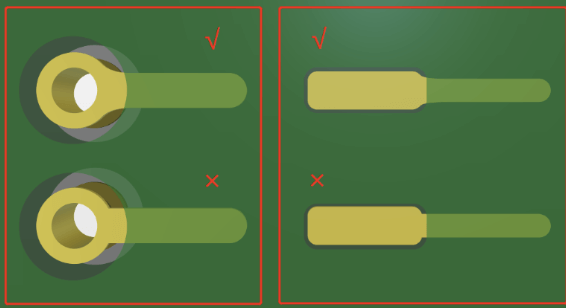
Close to the power pin: The filter capacitor should be placed as close to the power pin as possible to reduce the influence of the lead inductance on the filtering effect. In theory, capacitors have a certain decoupling radius range, so the principle of proximity should be strictly implemented.
Short and thick leads: The leads from the filter capacitor to the power pin should be as short and thick as possible to reduce parasitic inductance. The purpose of thickening the leads is to reduce the inductance value, thereby improving the filtering effect.
Reasonable drilling: For large-capacity filter capacitors or devices that need to pass large currents, as many holes as possible should be drilled on the PCB to disperse the current and reduce the risk of local overheating.
Optimize layout: When laying out the PCB, the trace length between the filter capacitor and the power pin should be minimized, and excessive current loops should be avoided. Smaller current loop area helps reduce electromagnetic radiation and interference.
3.Design details and precautions
In actual design, the following details and matters need to be paid attention to to ensure the effect of filter capacitors:
Choose the appropriate capacitor type: Choose the appropriate capacitor type according to the application requirements, such as aluminum electrolytic capacitors, tantalum capacitors or ceramic capacitors. Different types of capacitors have different characteristics, such as capacity, withstand voltage, ESR (equivalent series resistance), etc., and should be selected according to actual conditions.
Consider the temperature resistance of the capacitor: Electronic equipment working in a high temperature environment needs to choose filter capacitors with good temperature resistance to ensure that they will not fail due to excessive temperature during long-term operation.
Pay attention to the life and reliability of the capacitor: The life and reliability of the filter capacitor directly affect the overall performance of the power supply system. Therefore, when selecting a capacitor, you should pay attention to its service life, failure mode and reliability indicators.
Avoid capacitor parallel resonance: When multiple filter capacitors are used in parallel, you need to pay attention to avoid resonance between them. Resonance will cause the filtering effect to decrease or even fail, so this situation should be avoided through reasonable layout and circuit design.
Consider electromagnetic compatibility: When designing a power system, you need to pay attention to electromagnetic compatibility (EMC) issues. Reasonable arrangement of filter capacitors helps reduce electromagnetic radiation and interference and improve the EMC performance of the system.
4.Case analysis in practical applications
Taking a certain type of DC/DC power supply as an example, the arrangement of its input filter capacitors is as follows:
Large-capacity electrolytic capacitors: First place one or more large-capacity electrolytic capacitors at the input of the power supply to filter out low-frequency noise and ripple. These capacitors usually have large capacity and low ESR value, which can effectively smooth the DC voltage.
Small-capacity ceramic capacitors: After the large-capacity electrolytic capacitors, some small-capacity ceramic capacitors are connected in parallel. Ceramic capacitors have the advantages of good high-frequency characteristics, small size, and long life, and can effectively suppress high-frequency noise.
Layout optimization: When laying out the PCB, place the filter capacitor close to the power pin and connect it with short and thick leads. At the same time, reduce the current loop area and parasitic inductance through reasonable drilling and wiring.
Test verification: After completing the arrangement of the filter capacitors, test verification is required to ensure that its effect meets the design requirements. The test contents include but are not limited to voltage ripple, noise suppression effect and EMC performance.
5.Conclusion and Outlook
In summary, the arrangement of filter capacitors at the power input is of great significance for improving the stability of the power supply and reducing noise interference. Good filtering effects can be achieved by following the principle of “large first and small later”, reasonably selecting capacitor types, optimizing layout and wiring, and other strategies. In the future, with the continuous development of electronic technology and the application of new materials, the performance and reliability of filter capacitors will be further improved, providing more stable and pure power supply guarantee for electronic equipment.